A chilled water circuit in Kuwait runs almost every hour of the year, and most of the trouble it gives — corroded coil tails, noisy ceilings, air-locked branches, pumps that shake the header — starts within two metres of the equipment. Three small accessories decide whether that hookup lasts: the dielectric union where copper meets steel, the flexible connector where the machine meets the pipe, and the automatic air vent at the high point. This guide covers what each one does, the sizes and ratings on the TEMBO datasheets we supply from, and how they go together on a fan coil unit and in the plantroom.
Why the last two metres decide the circuit
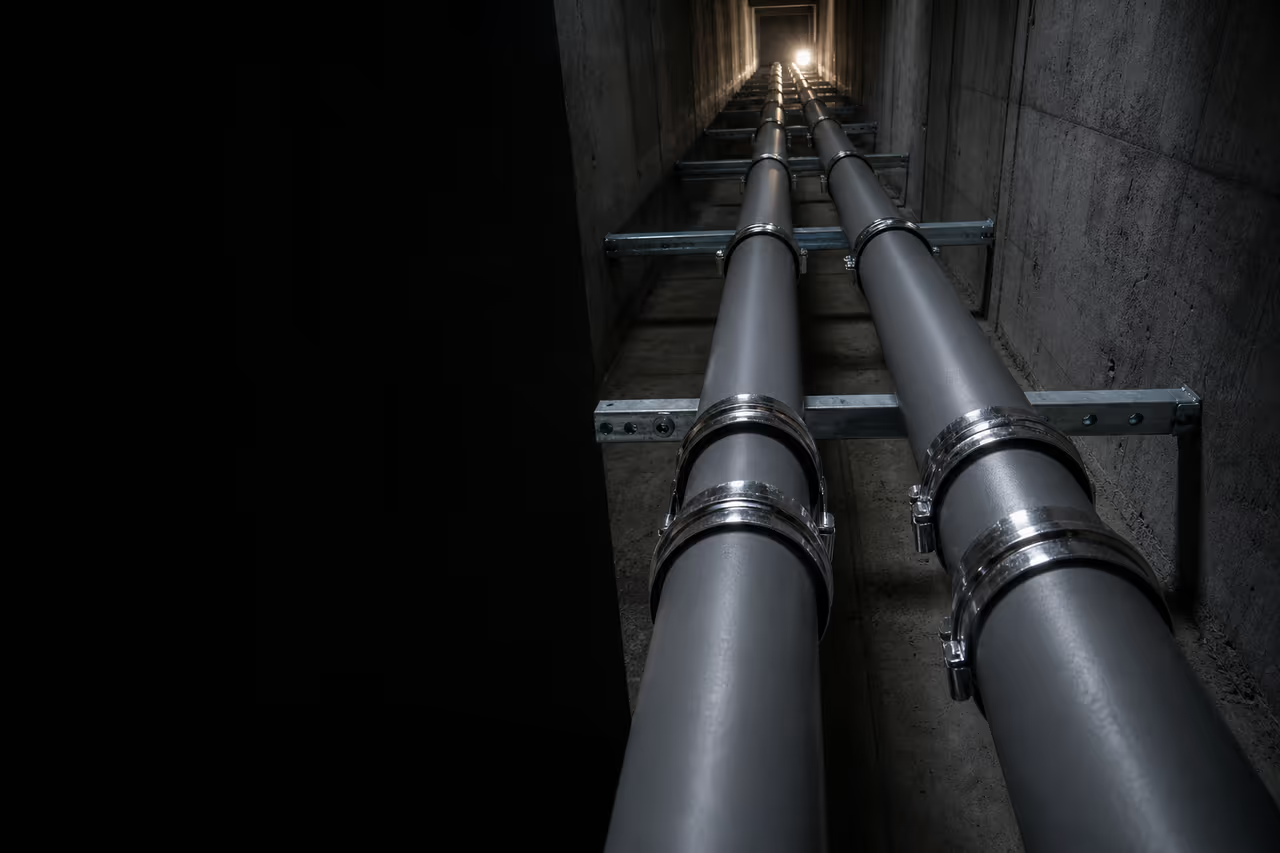
Distribution pipework is forgiving. It is one material, welded or grooved, hung on a support schedule, and insulated end to end. The hookup is where that uniformity breaks down: a copper or brass coil tail meets a black steel branch, a rotating machine meets a rigid pipe, and the highest point of the loop sits in a ceiling void nobody can see. Each of those transitions is a known failure point with a known fix, and each fix is a line item that gets deleted from a BOQ when the package is being trimmed.
Kuwait adds two pressures of its own. The cooling season is long enough that a chilled water system is effectively continuous duty, so a galvanic joint has more wet hours per year to corrode in than it would almost anywhere else. And summer humidity is high enough that any uninsulated fitting below the dew point sweats, which turns a slow corrosion problem into a visible drip on a ceiling tile. The accessories below are cheap relative to the coil, the pump, or the ceiling they protect.
Dielectric unions: what they do and when you need one
Put steel and copper in contact inside a water-filled pipe and you have built a battery. The two metals sit at different points on the galvanic series, the water is the electrolyte, and the less noble metal — the steel — gives up material to protect the copper. The corrosion concentrates at the joint, on the steel side, usually inside the fitting where nobody sees it until the thread weeps or the branch chokes with oxide.
A dielectric union interrupts that circuit. The steel half and the brass half of the union never touch: a nylon insulator sits between them and an elastomer gasket makes the pressure seal, so the joint is electrically broken while staying water-tight. The union nut also means the connection can be opened for service without cutting pipe, which is the second reason it belongs at every coil and every piece of equipment.
Where a dielectric break is required
- FCU and AHU coil tails — the coil headers are copper, the branch pipe is steel. This is the most common joint on any Kuwait chilled water project and the one most often left unprotected.
- Calorifiers, water heaters, and heat exchangers with copper or bronze connections on steel distribution.
- Plantroom tie-ins where a bronze pump casing, a brass valve train, or a copper service meets the steel header.
- Any copper-to-steel transition on a wet line, including condensate and make-up water connections.
One correction worth making early: a brass valve or a brass nipple between the steel and the copper is not a dielectric break. Brass conducts. It moves the galvanic couple along the pipe by one fitting and changes nothing else. Only a fitting with an insulating element between the two metals breaks the circuit.
Sizes, patterns, and ratings
The TEMBO range we supply in Kuwait splits at 2 inches. Below that, threaded unions in six connection patterns; above it, flanged unions to 8 inches.
| Range | Sizes | Connection patterns | Rating | Construction |
|---|---|---|---|---|
| Threaded union (TGDEU) | 1/2″, 3/4″, 1″, 1-1/4″, 1-1/2″, 2″ | Female or male NPT iron × female, male, or solder-end brass (six combinations) | 25 bar (362 psi) at 82 °C | Zinc-coated steel IPS half and nut, brass half, nitrile gasket, nylon insert |
| Flanged union, welded patterns (TGDEF) | 2-1/2″, 3″, 4″, 5″, 6″, 8″ | Weld-to-steel × FPT brass, MPT brass, or brazed copper end | 12.1 bar (175 psi) at 82 °C | Galvanised cast iron flange, bronze flange, EPDM gasket, nylon insulator, zinc-coated bolts |
| Flanged union, female × BPT (TGFF) | 2-1/2″ to 4″ (6″ and 8″ on request) | Female steel × BPT brass | 16 bar (232 psi) at 82 °C | As above |
Two numbers from that table govern most selections. The first is the 82 °C limit: chilled water, condenser water, LTHW, and pressurisation circuits all sit comfortably inside it, but a high-temperature hot water or steam connection does not, and the answer there is a different union material rather than a different accessory. The second is the pressure step at 2-1/2 inches: the threaded range is rated 25 bar, the flanged range 12.1 or 16 bar, so a PN25 riser that is fine with a threaded union at 2 inches needs the pattern checked against the circuit class once it moves to flanges.
A brass nipple between steel and copper is not a dielectric break. Brass conducts. Only an insulating element in the joint stops the cell.
Flexible connectors: rubber bellows or stainless braid
A pump, a chiller, or a fan coil unit moves. Rigid pipe does not. A flexible connector installed between the two does three jobs at once: it stops the machine’s vibration travelling down the pipe into the structure, it absorbs the axial movement that comes with temperature change, and it forgives the small misalignment that always exists between an equipment flange and a pipe that was hung before the equipment arrived. Without it, the pipe becomes the isolator, and the pipe is bad at that job — the vibration arrives at the first hanger and from there into the slab.
Which type goes where
The TEMBO range we stock in Kuwait has two families, and the choice between them is mostly about temperature, pressure, and what the specification says the connector must be made of.
| Type | Working pressure | Temperature | Best suited to |
|---|---|---|---|
| EPDM / neoprene bellows, triangular flange (TGTFC0) | 20 bar | −15 to +115 °C | Pump suction and discharge, chiller and condenser flanges, AHU coil connections on flanged pipe |
| EPDM / neoprene bellows, union type (TGUFC0) | 17 bar; vacuum to 700 mm Hg | −15 to +115 °C | Threaded connections on smaller lines, pump suction where vacuum service is possible |
| Stainless steel braided (TGFMC0), single or double braid | Per datasheet by size | Higher than the rubber range | FCU and AHU coil tails, hot water service, wherever the spec calls for metallic construction |
Rubber absorbs more vibration per unit length, which is why the bellows type is the default at pumps and chillers. The braided type takes over where temperature or pressure rule rubber out, and on the short flexible tails at fan coil units where the connection is threaded, the space is tight, and the specification usually asks for stainless. The bellows are reinforced with nylon cord and carry a pressurised steel wire safety ring; the flanges are forged steel, threaded to BS 21 with NPT available, and epoxy coated. Working media cover water, compressed air, oil, and weak acids or alkalis.
Installation notes that prevent the callback
- Support the pipe on both sides. A connector is not a hanger. The pipe immediately downstream needs its own support so the bellows are not carrying the pipe’s weight as a permanent offset.
- Stay inside the movement figures. The triangular-flange type in 3/4″ to 2″ is 160 to 180 mm long and rated for 22 mm elongation, 6 mm compression, and a 45° deflection angle. A connector installed stretched to close a gap has already used its movement.
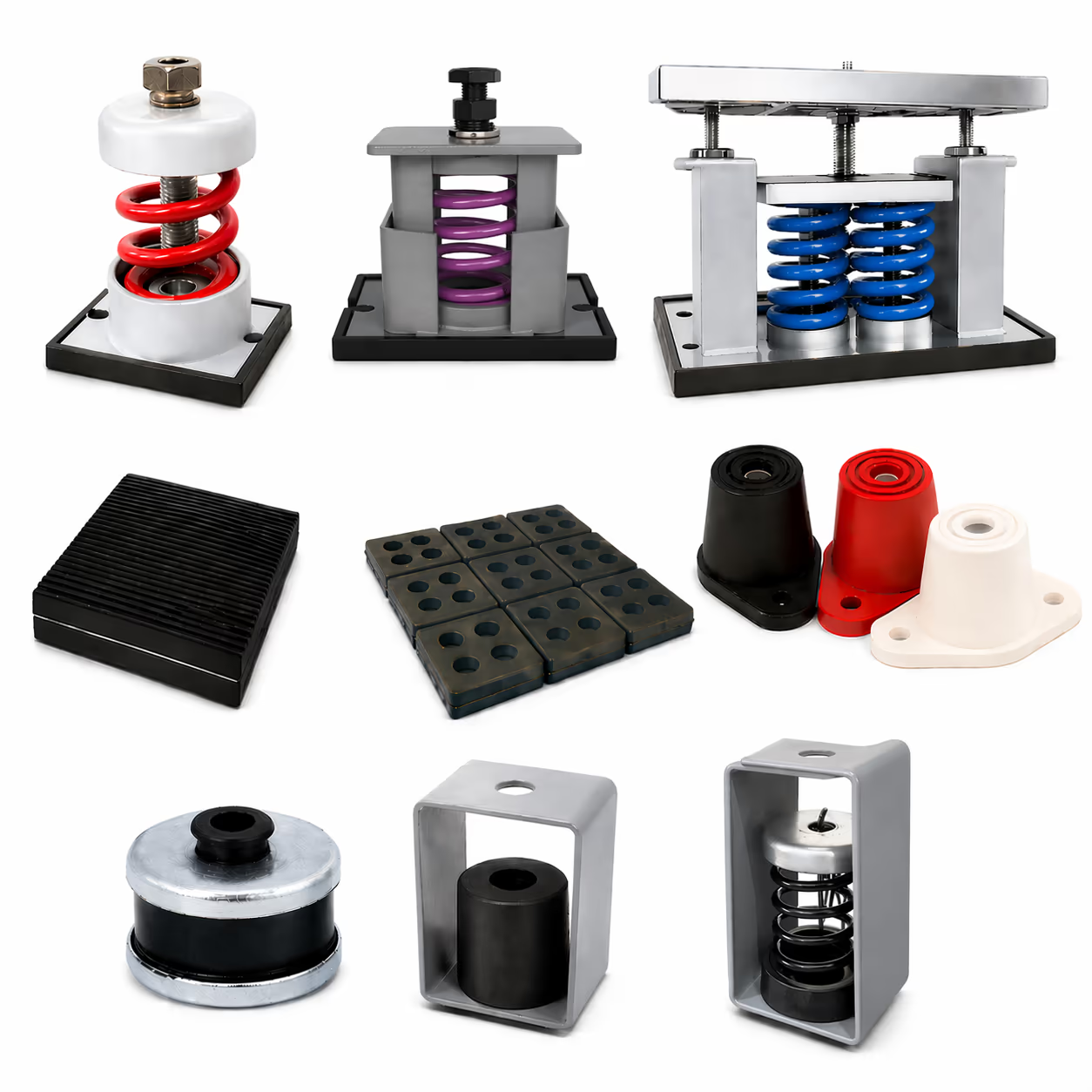
- Isolate the first supports too. A flexible connector stops vibration entering the pipe at the flange; it does nothing for vibration that bypasses it through the hanger rods. TEMBO’s own recommendation is to isolate the first two or three supports leaving the machine — see the vibration isolators range.
- Do not use the connector to correct misalignment beyond the deflection figure. Fix the pipe, not the bellows.

Automatic air vents: where the air collects
Air gets into every closed circuit. It arrives with the fill, it comes in with make-up water, and it comes out of solution every time the water warms or the pressure drops. Once it is in the system it migrates to the high points and stays there. At a coil it blankets the top tubes and cuts heat transfer; at a pump it causes noise and cavitation; everywhere it accelerates corrosion, because dissolved oxygen is what turns steel into oxide. A system that will not balance and a coil that will not reach duty are, more often than not, air problems.
An automatic air vent is a float valve that opens when air accumulates and closes against water. The TEMBO unit is a full brass body with a leakproof float, supplied complete with a 1/2″ MPT check valve so the vent body can be removed and serviced without draining the section — the check valve holds the system while the vent is off. Connection is 3/8″ or 3/4″, and the rating is 15 bar (217 psi) at up to 120 °C, which covers chilled water, condenser water, and LTHW.
Where to put them
- At the top of air bottles, air vessels, and air separators.
- At every high point of the piping system, including riser tops.
- At the top of cooling coils, evaporators, and radiators.
- On plantroom headers and pump suction manifolds.
Two Kuwait-specific details. The vent outlet carries a flare metal connection so a drip line can be run to the nearest drain; on a chilled water system that line is not optional, because a vent that discharges over a ceiling void will sweat and drip in summer. And the vent, its isolating valve, and the pipe stub it sits on all need to be insulated to the same standard as the main — an uninsulated brass vent on a 6 °C line is a condensation point by design.
The FCU hookup, item by item
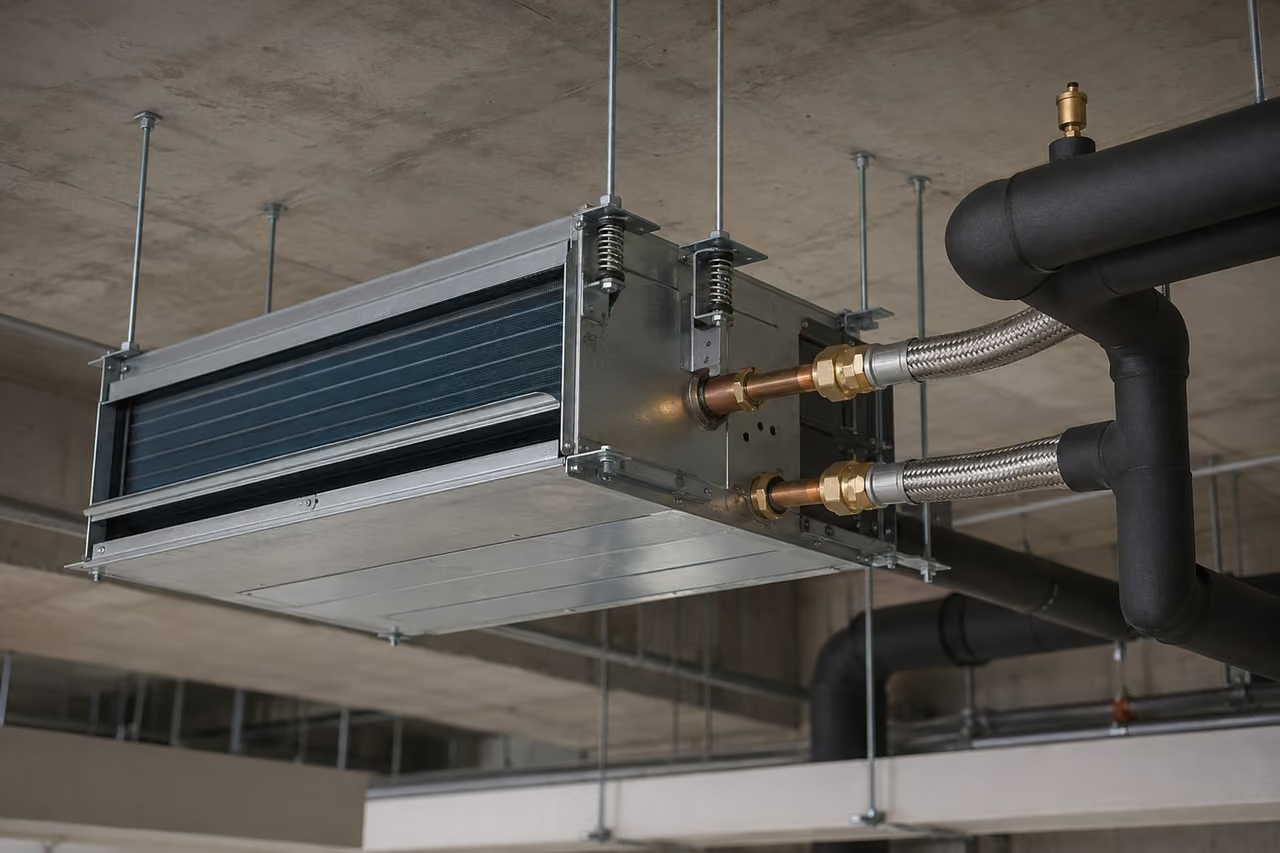
A fan coil unit is the one place where all three accessories, and the vibration isolators, land within a metre of each other. Taking a ducted unit hung from the slab on four rods, working from the structure down to the water:
| Position | Item | Selection | Why it is there |
|---|---|---|---|
| Hanger rod | Rubber hanger (TGRH00) or spring hanger (TGSPH0) | Type and mounting arrangement to the equipment schedule and acoustic specification | Breaks the vibration path into the slab |
| Coil connection | Stainless braided flexible connector | Sized to the coil tail; threaded ends | Takes the unit’s movement and the pipe’s misalignment |
| Copper-to-steel joint | Dielectric union, threaded (TGDEU) | 1/2″ to 2″; pattern chosen by the thread on each side; 25 bar, 82 °C | Stops the galvanic cell between coil and branch |
| Coil top / branch high point | Automatic air vent (TGAA), 3/8″ or 3/4″ | 15 bar, 120 °C, with check valve; drip line to drain; insulated | Clears the air blanket that stops the coil reaching duty |
| First two or three supports leaving the unit | Duct mount (TGDM00) or rubber hanger | Mount type and fixing arrangement to the support schedule | Stops vibration bypassing the hangers through the pipe and duct |
Send the FCU equipment schedule, suspension arrangement and acoustic specification with your enquiry. Explore the ceiling-suspended isolator range for spring hangers, rubber hangers and duct mounts.
The order of the items on the tail matters less than their presence, but the usual sequence from the coil outward is: flexible connector, isolating valve, dielectric union, then steel. Putting the union outboard of the valve means the valve train can be broken for service at the union without disturbing the coil connection.
Pump and chiller connections in the plantroom
The plantroom version of the same hookup is larger, flanged, and less forgiving of an omission, because a pump that shakes its header shakes the whole building.
- Flexible connectors at suction and discharge of every pump, and at every chiller and condenser connection. The triangular-flange EPDM type at 20 bar is the default; the union type with its 700 mm Hg vacuum rating suits suction lines that can pull below atmospheric.
- Flanged dielectric unions where a bronze pump casing or a bronze valve meets the steel header, in 2-1/2″ to 8″. Check the 12.1 or 16 bar rating against the circuit class before the submittal goes in.
- Air vents on the headers, at the top of the air separator, and at the pump suction manifold, each with a drip line to a floor drain.
- The pump on an inertia base on spring mounts, with the first pipe supports on either side isolated, so the connectors are not the only thing standing between the impeller and the slab. The inertia base and spring mount selections are on their own pages.
If the distribution pipe is composite rather than steel, the transitions move but the logic does not: the dielectric break is still needed where the composite system’s brass fittings meet steel plant, and the oxygen-tight wall of multilayer composite pipe is one of the reasons it gets specified on fan coil tails in the first place.
What to put on the schedule
Most HVAC accessory RFQs we receive in Kuwait are missing at least one of the five things needed to return a product code. For a priced offer within 24–48 hours, each line needs:
- Size, and for a union or connector, the size on both sides if they differ.
- Connection type at each end — FPT, MPT, solder end, flanged, and the flange standard if flanged.
- The two materials being joined, for dielectric unions. Steel to copper and steel to bronze take different patterns.
- Circuit pressure class and maximum temperature — PN10, PN16, or PN25, and whether anything runs above 82 °C.
- Media — chilled water, condenser water, LTHW, glycol mix, or something else.
Send that, or the consultant’s accessory schedule as issued, through the contact page and the technical desk will return the matching TEMBO codes, flag any line where the rating does not cover the circuit, and price it. The full range with datasheets is on the HVAC accessories page.
Frequently asked questions
What is a dielectric union and when do I need one?
A dielectric union is a pipe union with a nylon insulator and an elastomer gasket separating its steel half from its brass half, so steel and copper or brass can be joined without touching. You need one at every wet joint between the two metals — FCU and AHU coil tails, calorifier and heat exchanger connections, and plantroom tie-ins — because without it the joint becomes a galvanic cell and the steel side corrodes.
Can a brass valve or nipple act as a dielectric break?
No. Brass conducts electricity, so a brass fitting between steel and copper simply moves the galvanic couple along by one fitting. Only a fitting with an insulating element between the two metals interrupts the cell.
What pressure and temperature are dielectric unions rated for?
The TEMBO threaded range, 1/2″ to 2″, is rated 25 bar (362 psi). The flanged range, 2-1/2″ to 8″, is rated 12.1 bar (175 psi) for the welded-to-steel patterns and 16 bar (232 psi) for the female × BPT pattern. Both ranges are limited to 82 °C (180 °F).
Rubber bellows or stainless braided flexible connector for an FCU?
Stainless braided, in most cases. FCU tails are threaded, short, and often specified as metallic; the braided type suits all three. Rubber bellows connectors are the default at pumps, chillers, and flanged AHU connections, where they absorb more vibration per unit length at up to 20 bar and 115 °C.
Where should automatic air vents go on a chilled water system?
At the top of air separators, bottles, and vessels; at every high point of the pipework including riser tops; and at the top of cooling coils and evaporators. Each vent needs a drip line to a drain and the same insulation as the pipe it sits on, or it becomes a condensation point in a Kuwait summer.
Do I still need vibration hangers if the FCU has flexible connectors?
Yes. The connector stops vibration entering the pipe at the coil. It does nothing for vibration travelling down the hanger rods into the slab, which is the path that produces noise in the room below. The rods need rubber or spring hangers sized on the load per point, and the first two or three pipe and duct supports leaving the unit should be isolated as well.
Send the accessory schedule or BOQ with sizes, end connections, the two metals being joined, and the circuit pressure class. The technical desk returns the matching TEMBO codes, flags any line the rating does not cover, and prices it.
Also useful:Dielectric unions & flangesFlexible pipe connectorsFCU & plant vibration isolators