On a Kuwait tower, the riser is where a plumbing specification is really decided. Branch pipework tolerates almost anything; a 60-metre vertical main carrying 70 °C water through a shaft you cannot revisit does not. This is a working comparison of the three materials that actually get proposed for that duty — multilayer composite, PEX, and PPR — written for the consultant reviewing the submittal and the contractor pricing the shaft.
Why the riser decides the material
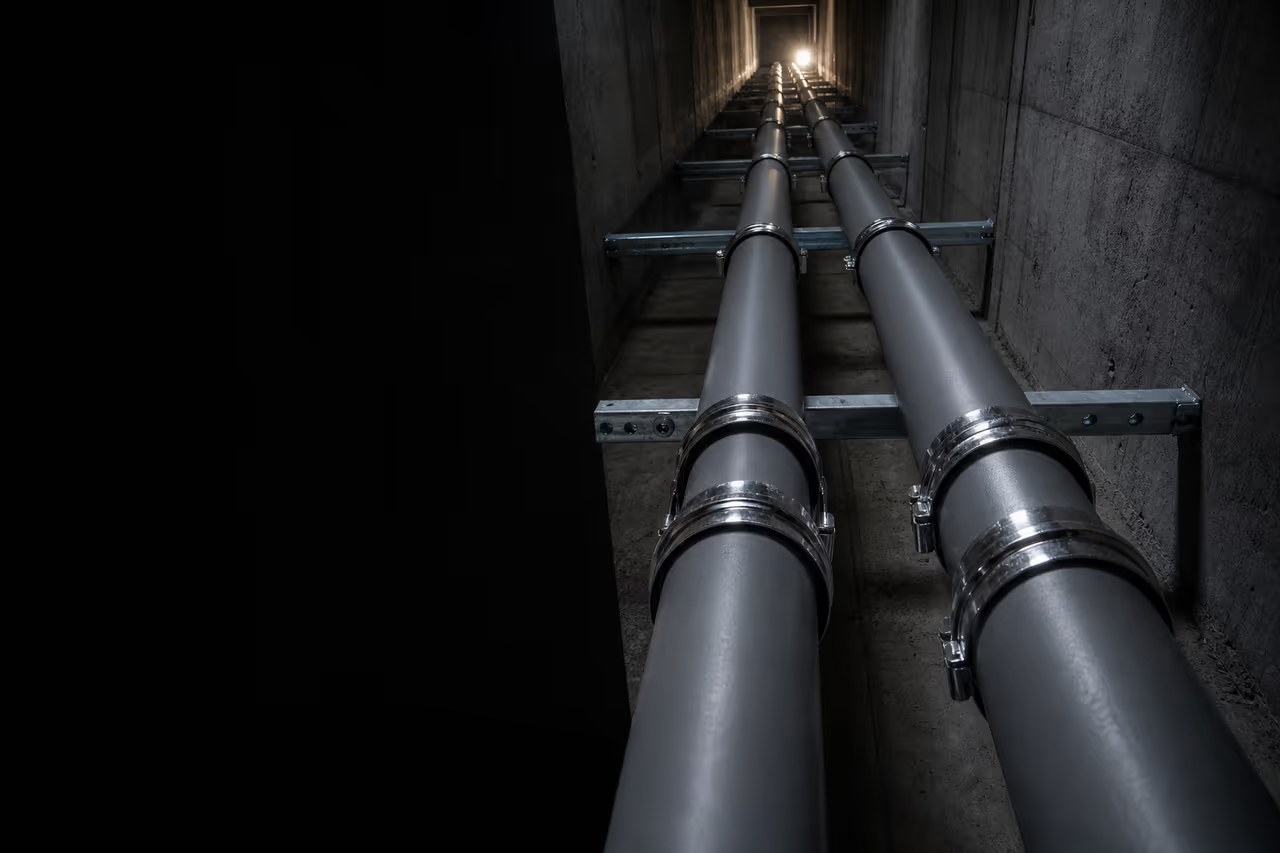
A riser has four properties a branch run does not. It is long, so thermal movement accumulates over a distance nothing absorbs. It is vertical, so the pipe’s own water-filled weight lands on the supports rather than being spread along a ceiling. It is enclosed, so jointing happens in a shaft with restricted access and often a hot work restriction. And it is permanent — the one part of the distribution system nobody plans to open again.
Those four facts push the decision away from cost per metre and toward four numbers: how much the pipe grows when it heats, whether it lets oxygen through, how the joint is made, and how much water it carries for a given outside diameter. The rest of this guide is those four numbers.
The three candidates, described plainly
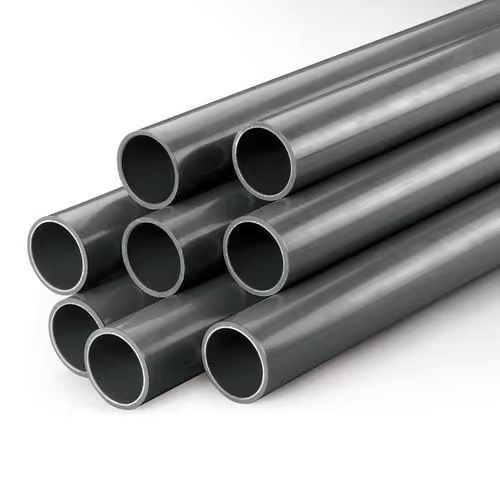
PPR (polypropylene random copolymer, correctly written PP-R) is the incumbent across most of the GCC. It is rigid, cheap per metre, available to 125 mm, and joined by socket fusion — a hot plate that melts the pipe and the fitting and pushes them together. Every plumber in Kuwait can weld it. That familiarity is a genuine advantage and should not be dismissed.
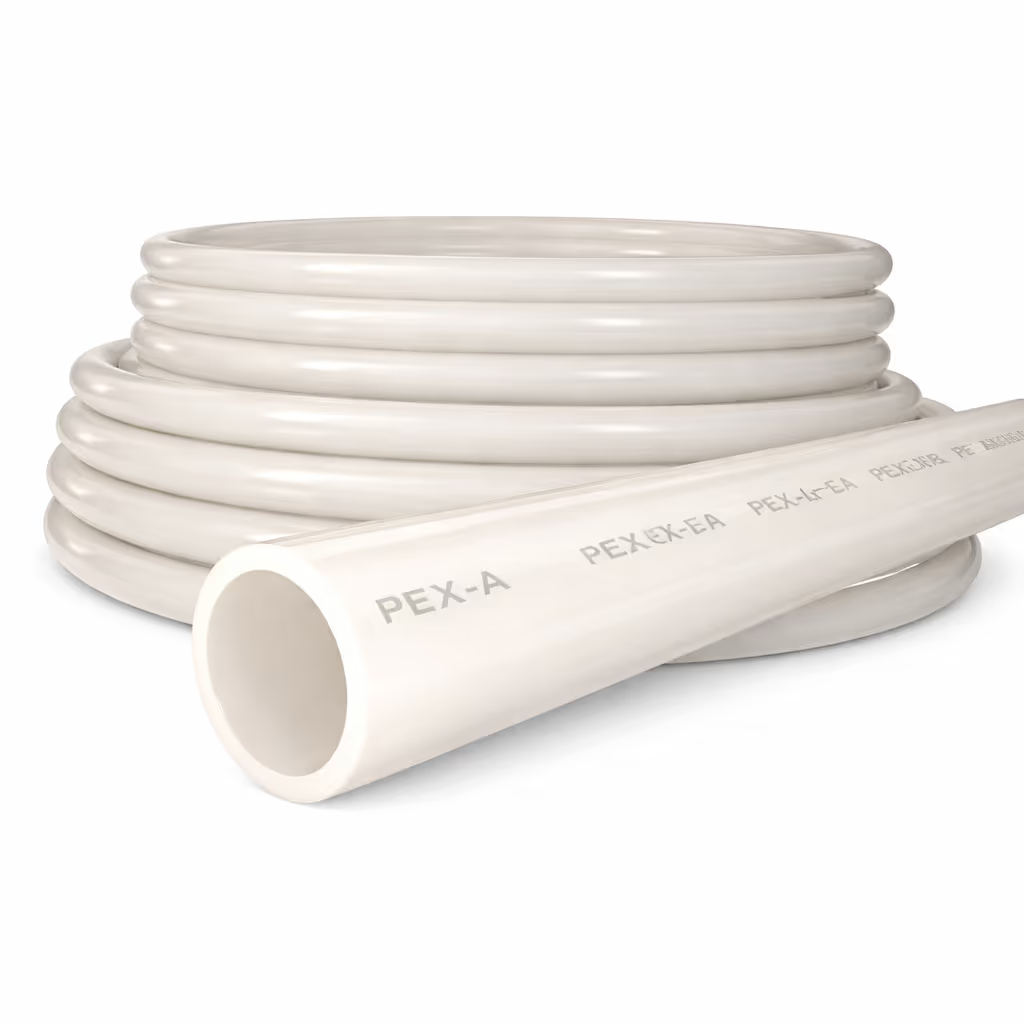
PEX — cross-linked polyethylene, in practice PE-Xa to EN ISO 15875 — is the opposite temperament: flexible, coiled in long lengths, jointed cold, and effectively immune to the chloride and scale problems that end copper. It runs 16 to 63 mm in normal supply, which is where its riser story runs out.
Multilayer composite — MLC, also sold as PEX-AL-PEX or simply composite pipe — is a five-layer wall: an inner and outer skin of high-temperature polyethylene (PE-RT) bonded by adhesive layers to an aluminium tube that is folded around the pipe and welded along its length. It is covered by EN ISO 21003, the standard written specifically for multilayer piping systems, and we supply it from 16 to 110 mm across the range on the multilayer composite pipes page.
The aluminium is the whole argument. It is not a liner or a coating — it is a structural layer, and it gives the pipe three properties no all-plastic pipe has: it blocks oxygen completely, it holds a bend instead of springing back, and it drags the thermal expansion of the composite down close to metal.

Expansion: the number that ends most arguments
Take 50 metres of riser and put it through a 50 K temperature swing — a cold fill in a shaft at ambient, then hot water at design flow. That is an ordinary commissioning day in Kuwait, not a worst case. What each material does:
| Material | Growth over 50 m at Δt 50 K | What the design has to absorb it |
|---|---|---|
| PP-R | 450 mm | Expansion loops, many guides, generous anchor design |
| PEX (PE-Xa) | ≈375 mm | Loops plus restraint against snap-back |
| Multilayer composite | 62.5 mm | One expansion leg, few fixing points |
| Copper | 41.3 mm | One expansion leg |
Composite moves about one seventh as much as PPR over the same run and temperature change, because the aluminium — with a coefficient of 25 × 10−6 m/(m·K) for the finished composite — governs the wall it is bonded into. That is not a marginal improvement in a shaft. It is the difference between a riser that needs a designed expansion loop at every floor group and one that needs a fixed point, a leg, and clips.
450 mm of growth is a design problem. 62.5 mm is a detail.
Oxygen, and what it corrodes downstream
Plastic pipe is permeable to oxygen. On a closed hydronic circuit — chilled water, heating, fan coil tails — oxygen diffusing through the pipe wall does not damage the pipe at all. It corrodes the steel components downstream: the pump volutes, the strainers, the coil headers, the fan coil units themselves. The pipe outlives the plant it feeds, which is a poor trade.
- PP-R has no oxygen barrier in its standard form. This is the single most common reason a consultant rejects it for closed circuits.
- PEX needs an added EVOH layer to meet the same requirement. Barrier PEX exists and works — but it is a specification item that has to be asked for, checked on the submittal, and confirmed on the delivered pipe.
- Composite is diffusion-tight by construction. The aluminium is not a coating that can be scored, thinned at a bend, or quietly omitted from a substitution. If the pipe is composite, the barrier is there.
For potable hot and cold water this argument does not apply and PPR remains a legitimate choice. For chilled water, secondary circuits, and fan coil connections it usually decides the matter on its own.
Two small accessories close out the same corrosion story at the plant connections: automatic air vents at riser high points purge the air that does find its way in, and dielectric unions and flanges isolate the joint where the circuit transitions to steel or copper equipment, so dissimilar-metal contact does not set up its own corrosion cell.

Jointing in an occupied shaft
PPR is joined by socket fusion: a hot plate at working temperature, held in the shaft, with an open heat source and a permit to match. On a live site, in an occupied building, or on a floor that has already been handed over, that permit is frequently the constraint that removes PPR from consideration regardless of its technical merits.
Composite and PEX are both jointed cold. On composite the standard method is a press fitting: the pipe is cut, calibrated and bevelled, pushed home, and a press jaw closes the sleeve. Inspection windows confirm insertion depth before pressing, and the coloured stop ring breaks off as the jaw closes — so an unpressed joint is visible from across the room rather than discovered at the pressure test. Above 63 mm the modular riser system takes over: 39 components covering every riser, manifold, and main to 110 mm, pressed at the bench and assembled in the shaft by insert-and-lock. Nothing is tooled overhead.

Bore, and why a thick wall costs a size
PPR achieves its pressure rating with wall thickness, and that wall comes out of the bore. At the same nominal outside diameter, composite carries measurably more water:
| Outside diameter | Composite bore | PP-R SDR 6 bore | PP-R SDR 7.4 bore |
|---|---|---|---|
| 20 mm | 15.5 mm | 13.2 mm | 14.4 mm |
| 25 mm | 20.0 mm | 16.6 mm | 18.0 mm |
| 32 mm | 26.0 mm | 21.2 mm | 23.2 mm |
| 63 mm | 51.0 mm | 42.0 mm | 45.8 mm |
| 110 mm | 90.0 mm | 73.4 mm | 79.2 mm |
A 63 mm composite riser carries roughly the water of a 75 mm PPR riser. On a long run, or at the far end of a distribution main where residual pressure is marginal, that frequently lets a designer hold pressure without stepping up a size — which claws back part of the material cost difference in fittings, valves, insulation, and shaft space.
Copper still carries more water per outside diameter than any plastic. The trade-offs there are corrosion behaviour in saline conditions, jointing method, and cost — a different conversation from this one.
Side-by-side comparison
| Criterion | Multilayer composite | PEX (PE-Xa) | PP-R |
|---|---|---|---|
| Standard | EN ISO 21003 | EN ISO 15875 | EN ISO 15874 |
| Size range supplied | 16–110 mm | 16–63 mm typical | 20–125 mm |
| Expansion, 50 m at Δt 50 K | 62.5 mm | ≈375 mm | 450 mm |
| Oxygen barrier | Built in (aluminium) | Needs an EVOH layer | None |
| Shape after bending | Holds the bend | Springs back | Rigid, fittings only |
| Fixing points needed | Few | Many, restrains snap-back | Many, rigid |
| Jointing on site | Press / compression | Cold expansion / press | Heat fusion |
| Hot work permit | Not required | Not required | Required (hot plate) |
| Bore at the same OD | Largest of the three | Comparable | Smallest, thick wall |
| Material cost per metre | Highest | Middle | Lowest |
Composite is the most expensive of the three per metre. Any comparison that stops at that line is incomplete — the installed cost moves with fixing point count, expansion detailing, permit constraints, and whether the bore lets you hold a size — but the line is real and should be stated plainly to the client.
Choosing, service by service
Domestic hot and cold risers
Composite for anything tall or long, where the expansion arithmetic and the 16 to 110 mm single-system range earn their premium. PPR remains defensible on low-rise residential where runs are short, the crew already knows the material, and no closed circuit is involved.
Chilled water and fan coil tails
Composite, on the oxygen argument alone. This is the application where the aluminium core stops being a nice property and becomes the reason the plant survives its design life. PEX with a verified EVOH barrier is the alternative; unbarriered PPR is not one.
Coiled branch pipework and underfloor
PEX. Long coils, tight bends, and low cost per metre are exactly what branch work wants, and none of the riser arguments apply. Many Kuwait projects correctly run both: composite for risers and distribution, PEX for coiled branch runs. They are complementary systems, not competing ones.
Occupied buildings, phased handover, and refurbishment
Composite or PEX, because the hot work permit disappears. On a floor that has already been handed over, this is usually the entire decision.
Large rigid distribution above 110 mm
PPR keeps the range advantage to 125 mm, and above that the conversation moves to steel or HDPE depending on service and burial. Composite stops at 110 mm.
Whichever material carries the riser, the support package is sized on the water-filled weight, and composite is clipped more closely than a rigid pipe of the same diameter — the pipe supports and hangers range covers the lined clamps and channel for all three systems.
Frequently asked questions
Is MLC better than PPR?
Not universally. Composite wins decisively where thermal movement, oxygen ingress, or hot work restrictions drive the design — risers, chilled water, fan coil tails, occupied buildings. PPR keeps the advantage on material cost per metre, on rigid distribution, and on sizes above 110 mm. On a short low-rise potable run with none of those constraints, PPR is a perfectly sound specification.
How is MLC different from PEX?
Three practical differences. Composite holds its shape after bending where PEX springs back, so it needs far fewer fixing points. Composite carries a built-in oxygen barrier from the aluminium; PEX needs an added EVOH layer for the same result. And composite expands about a quarter as much as PEX for the same temperature change. PEX still wins on long coiled branch runs and on the tightest bends.
What sizes does multilayer composite pipe come in?
Ten dimensions from 16 to 110 mm: 16×2, 20×2.25, 25×2.5, 32×3, 40×4, 50×4.5, 63×6, 75×7.5, 90×8.5, and 110×10 mm. Small sizes come coiled up to 500 m as well as in 5 m straight lengths; from 40 mm up it is straight lengths only.
Does composite pipe need an oxygen barrier added?
No. The aluminium core is the barrier, and it is diffusion-tight by construction rather than a coating that can be scored or left off a substitution. That is the main reason composite gets specified on fan coil tails and secondary chilled water circuits.
What temperature and pressure can composite pipe handle?
Class 2 hot and cold water service: 70 °C continuous at 10 bar, with short-term peaks to 95 °C. That envelope covers domestic hot water, recirculating loops, chilled water, and low-temperature heating.
How do I get a priced comparison for my project?
Send the riser diagram, plumbing schedule, or BOQ through the contact page and our technical desk will return a priced offer with the material selection commented against your specification — including where we think a cheaper material would do the job.
Send the riser diagram, plumbing schedule, or BOQ and our technical desk returns a priced offer with the material selection commented against your specification — including where a cheaper material would do the job.
Also useful:PEX piping systemHVAC accessoriesPipe supports & hangers