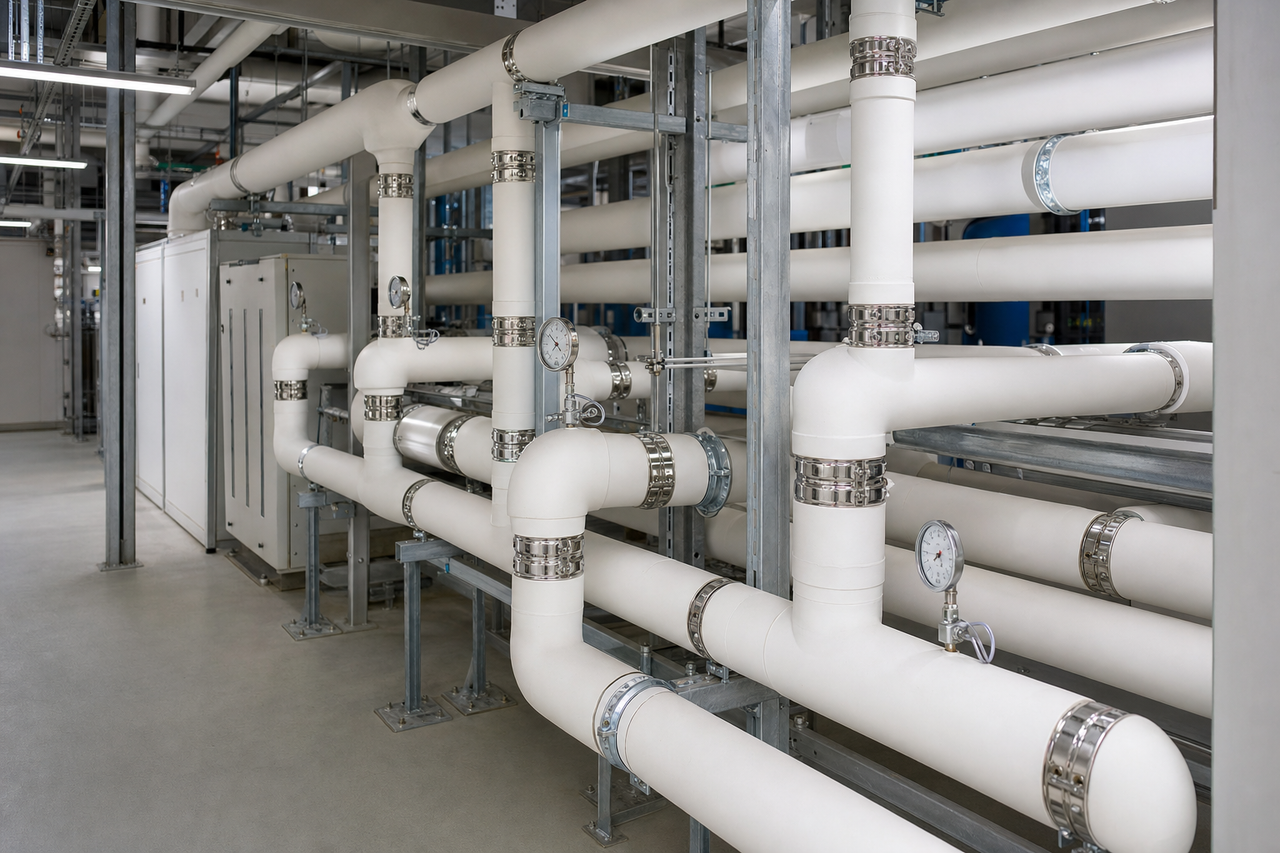
Multilayer composite pipes that keep their shape and keep oxygen out.
Five-layer PE-RT and aluminium pipe, 16 to 110 mm, with press fittings and a modular riser system. Stocked in Kuwait, quoted within 24–48 hours.

- PE-RT / AL / PE-RT
- 5 layers
- Ten dimensions
- 16–110 mm
- Continuous / peak
- 70 / 95 °C
EN ISO 21003 · Class 2Tap water / Risers / Chilled water
One pipe, five ways to joint it.
Press fittings to 50 mm, the modular riser system above, and prefab outlets at the wall. One crew, one stock list.
- 01 / Pipe
 16-110 mm
MLC Composite Pipe
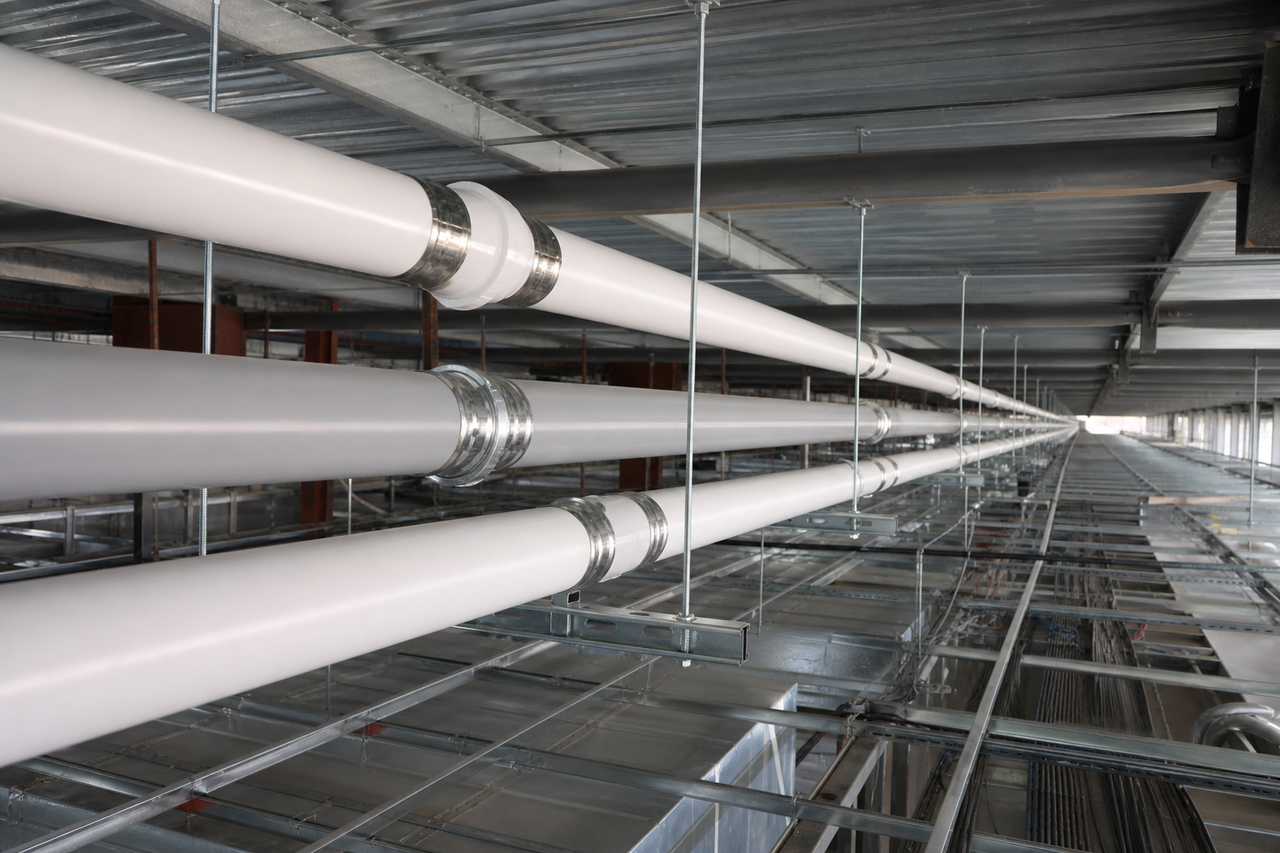
Inner and outer high-temperature PE-RT bonded to a longitudinally welded aluminium core.
- 02 / Press fittings
 16-50 mm
Metal Press Fittings
The standard joint, 16-50 mm.
- 03 / Composite fittings
 16-50 mm
PPSU Composite Fittings
The economy fitting, 16-50 mm.
- 04 / Riser system
 63-110 mm
Modular Riser System
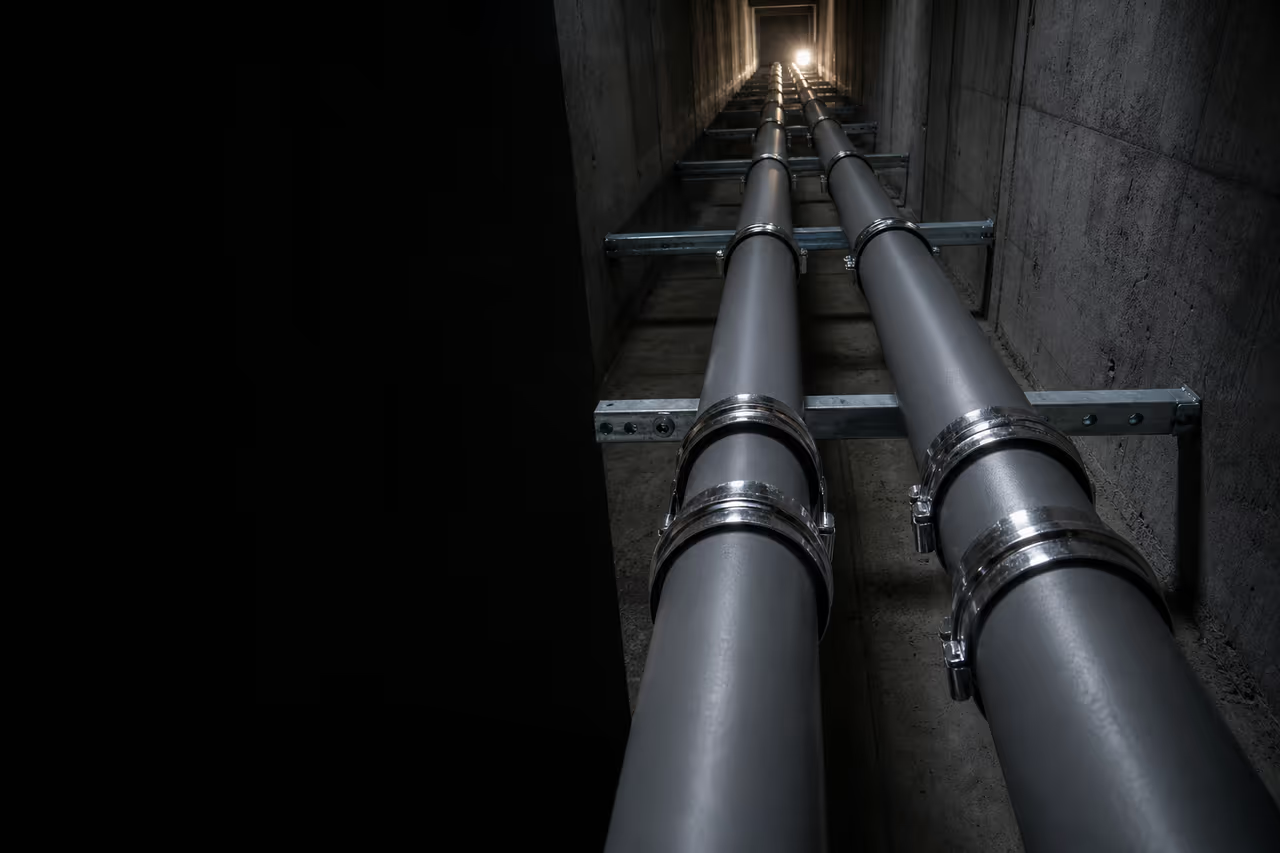
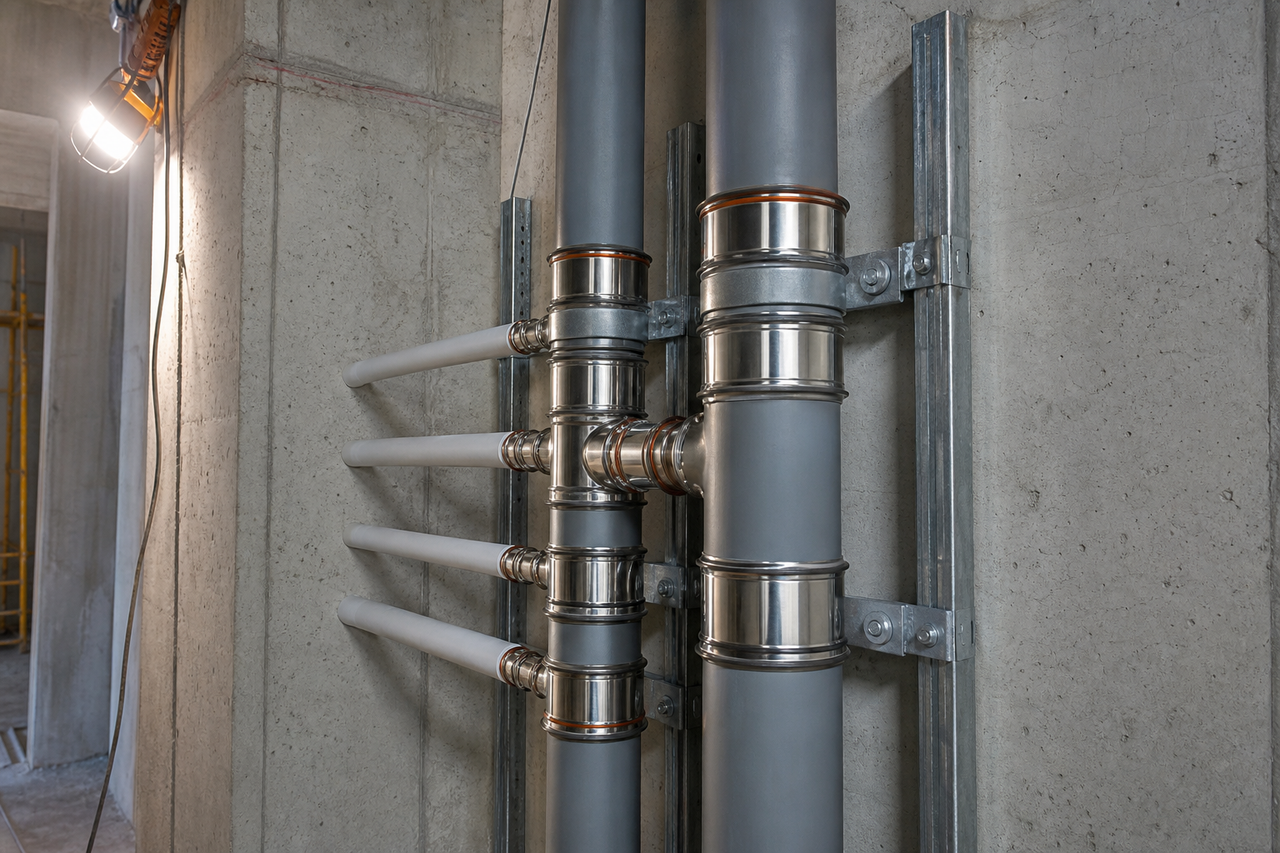
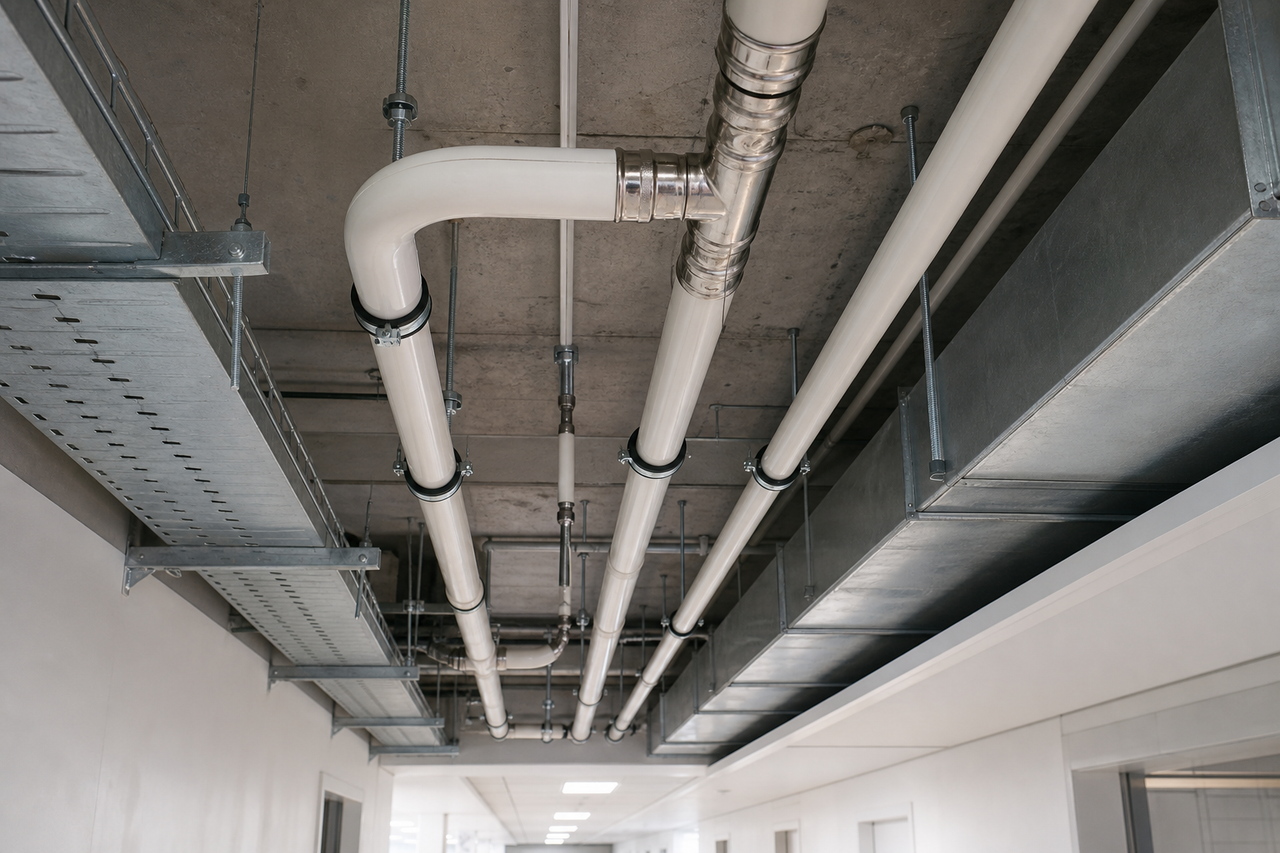
Thirty-nine components cover every 63-110 mm riser, manifold, and main.
- 05 / Compression
 16-25 mm
Compression & Eurocone
Screw fittings, 16-25 mm, including ¾" eurocone, for radiator, fan coil, and appliance tails that must stay demountable for service.
- 06 / Prefabricated
 Wall outlets
Tap Elbows & Plates
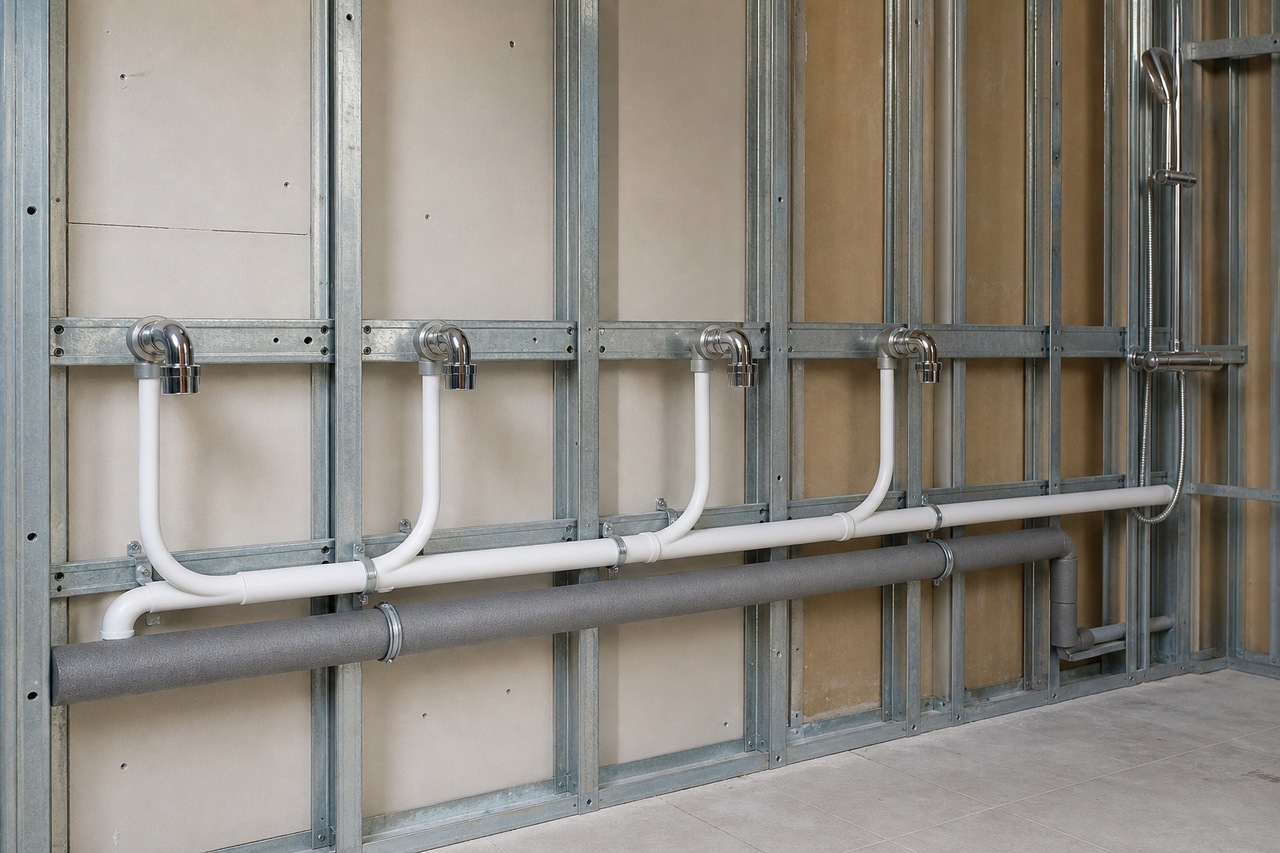
Wall-outlet elbows, plates, angles, and rails, positioned and fixed one-handed.


Metal behaviour, plastic handling, one wall.
All five layers are permanently bonded. Cut the pipe anywhere and the wall behaves as a single material. Bend it and the aluminium keeps the shape; heat it and the aluminium keeps the length.
- PE-RT outer skinCorrosion-free jacket. No scale, no rust, nothing to paint
- AdhesivePermanent bond
- Aluminium core, overlap-welded along its length100% oxygen barrier · holds the bend · one-seventh the expansion of PP-R
- AdhesivePermanent bond
- PE-RT inner boreHygienically smooth at k = 0.0004 mm, so full flow lasts the life of the system
- Product standard
- EN ISO 21003
- Application class
- Class 2 hot and cold
- Operating envelope
- 70 °C continuous, 10 bar
- Size range
- 16–110 mm, ten dimensions
Four site problems, one core.
Movement, hot work, oxygen, and corrosion are what cost money on a Kuwait plumbing or HVAC package. The welded aluminium core answers all four.
 5 × OD
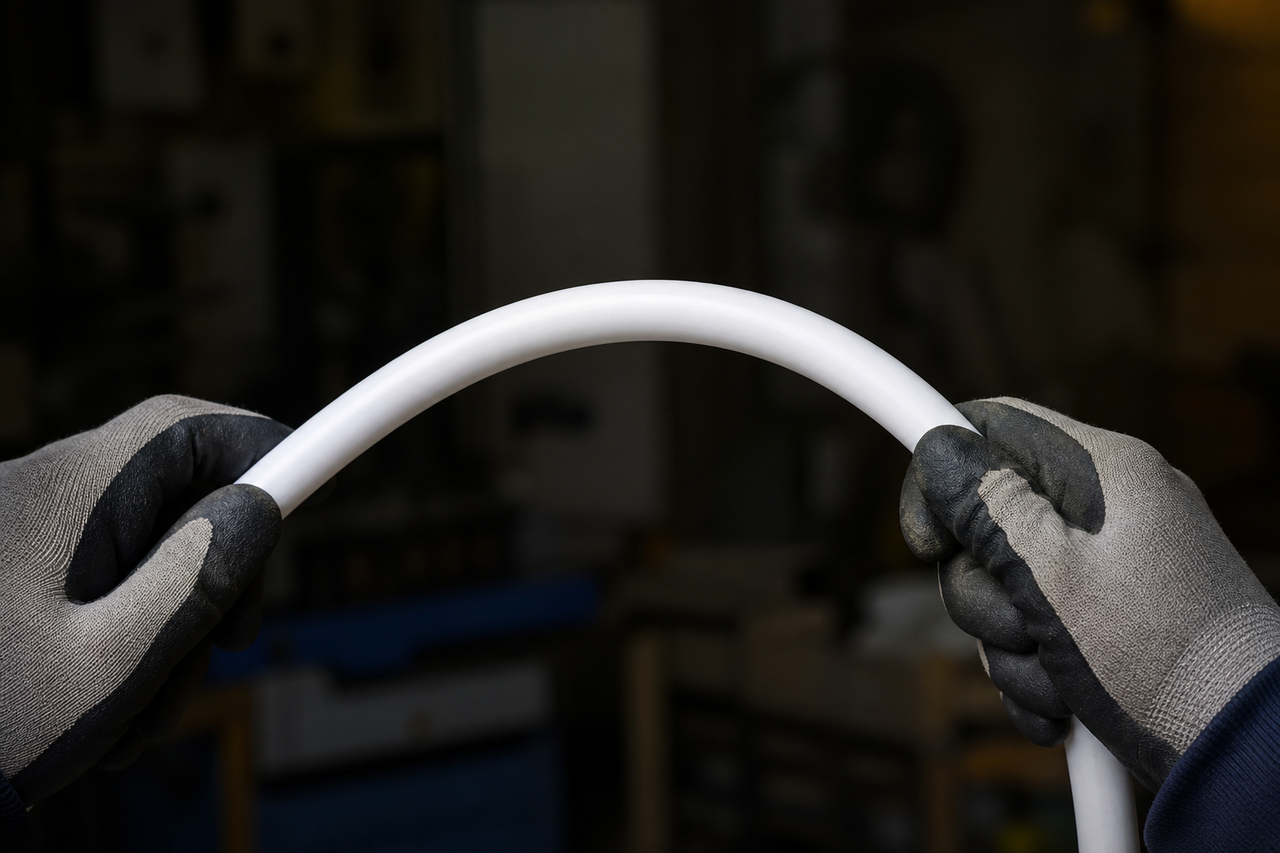
Holds the bend
Bend it by hand and it stays bent. Fewer fixings, fewer elbows.
 62.5 mm
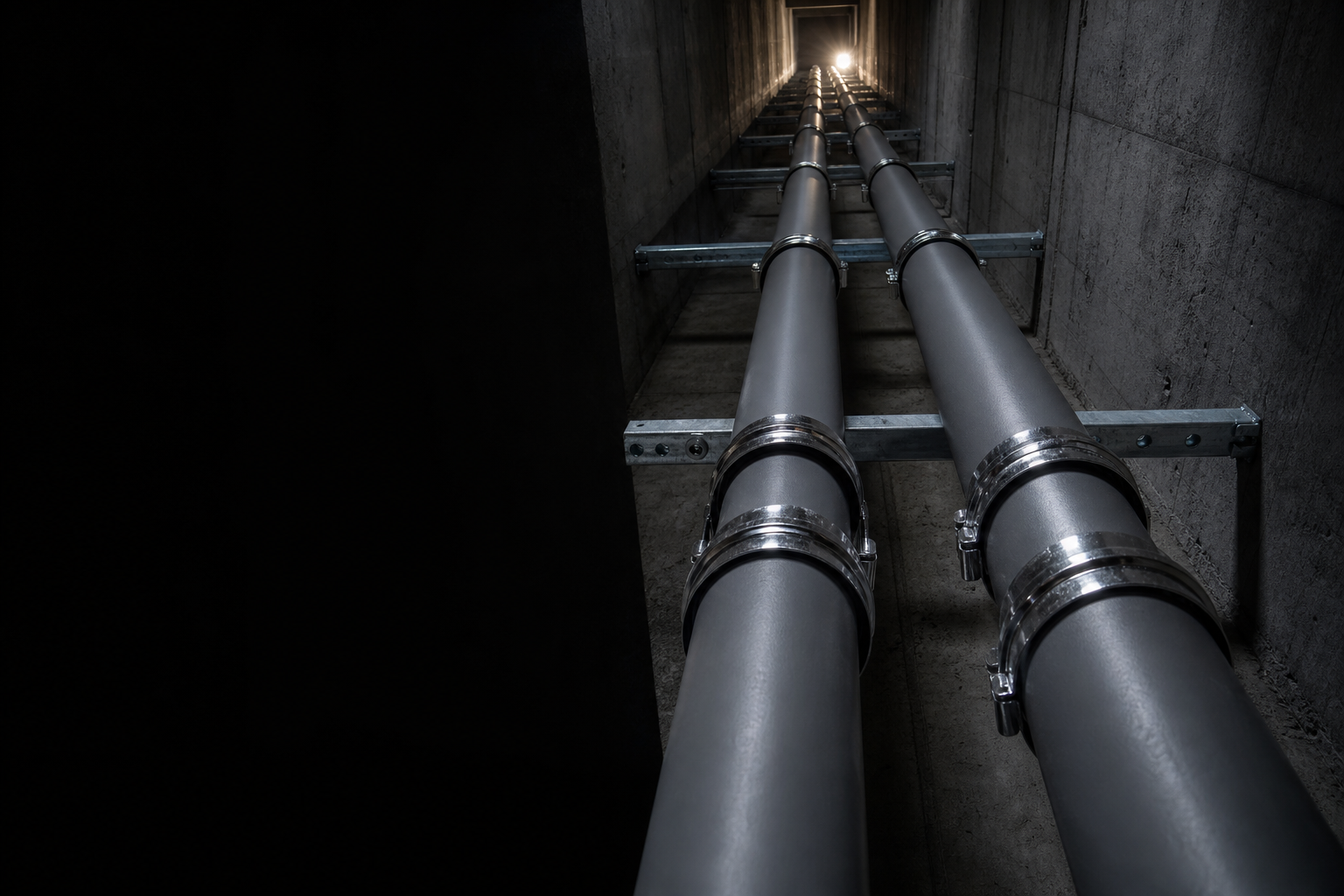
One-seventh the movement of PP-R
50 m at a 50 K swing moves 62.5 mm. The same run in PP-R moves 450 mm.
 0 permits
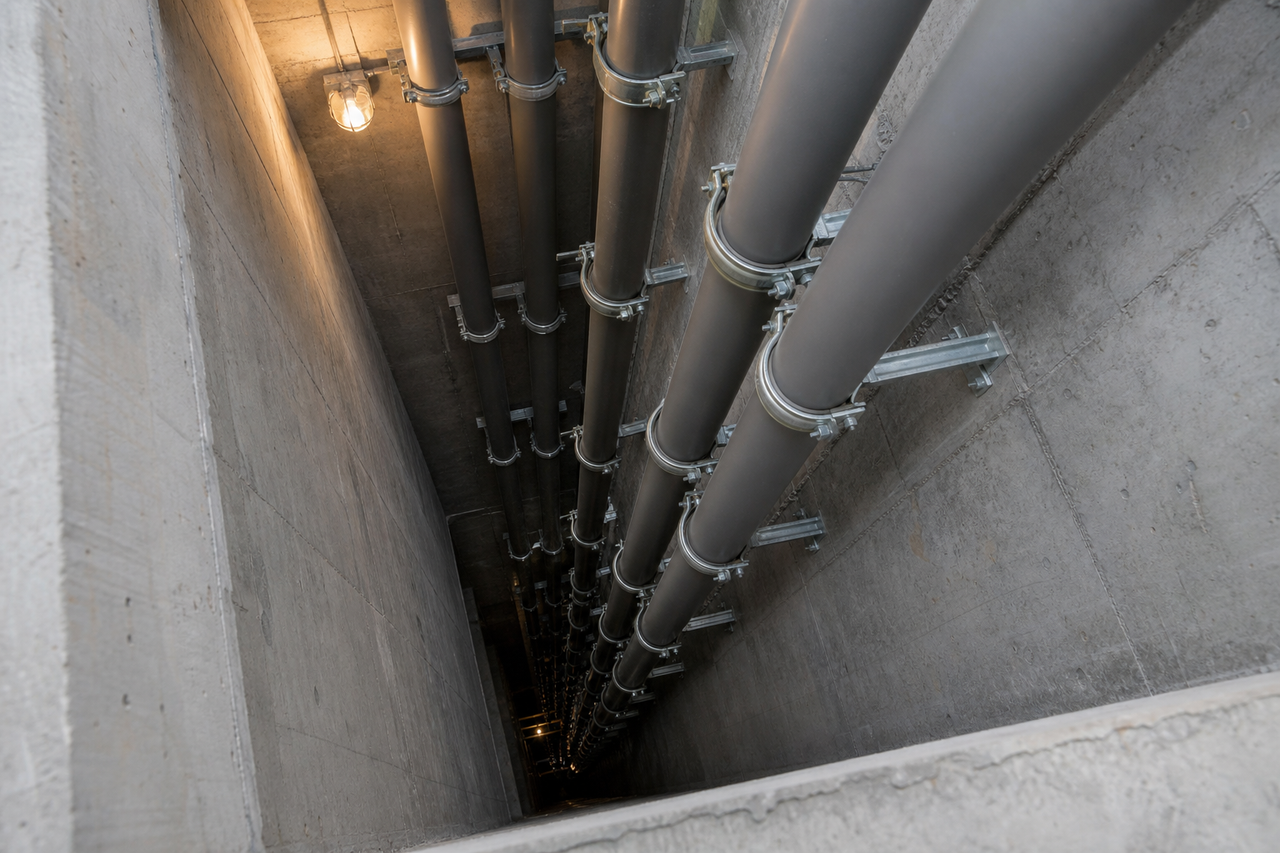
No flame, no hot work
Every joint is pressed or screwed cold, even on a live hospital floor.
 100%
100%Oxygen-tight by construction
The welded aluminium is the barrier. Nothing to score, nothing to omit.



Thermal expansion by pipe material
Length change over a 50 m run at Δt = 50 K. The aluminium core is what holds multilayer composite to 62.5 mm, roughly one-seventh of PP-R over the same run, and within striking distance of copper.
The numbers to size and support it.
One sheet open at a time. Dimensions and weights first, because that is what the clamp schedule needs. The full data set ships with every quote.
Dimensions, weights, and delivery formats
Water-filled weight is the figure to use when sizing clamps and hangers. It is what the support actually carries.
| Dimension OD × s | Inner Ø | Water volume | Weight, empty | Weight, water-filled | Supplied as |
|---|---|---|---|---|---|
| 16 × 2.0 | 12.0 mm | 0.113 l/m | 105-118 g/m | 218-231 g/m | Coil 100 / 200 / 500 m · 5 m straight |
| 20 × 2.25 | 15.5 mm | 0.189 l/m | 148-160 g/m | 337-349 g/m | Coil 100 / 200 m · 5 m straight |
| 25 × 2.5 | 20.0 mm | 0.314 l/m | 211-240 g/m | 525-554 g/m | Coil 50 / 100 m · 5 m straight |
| 32 × 3.0 | 26.0 mm | 0.531 l/m | 323 g/m | 854 g/m | Coil 50 m · 5 m straight |
| 40 × 4.0 | 32.0 mm | 0.800 l/m | 508 g/m | 1,310 g/m | 5 m straight |
| 50 × 4.5 | 41.0 mm | 1.320 l/m | 745 g/m | 2,065 g/m | 5 m straight |
| 63 × 6.0 | 51.0 mm | 2.040 l/m | 1,224 g/m | 3,267 g/m | 5 m straight |
| 75 × 7.5 | 60.0 mm | 2.827 l/m | 1,788 g/m | 4,615 g/m | 5 m straight |
| 90 × 8.5 | 73.0 mm | 4.185 l/m | 2,545 g/m | 6,730 g/m | 5 m straight |
| 110 × 10.0 | 90.0 mm | 6.362 l/m | 3,597 g/m | 9,959 g/m | 5 m straight |
Where two weights are shown, the first is coiled pipe and the second is straight length. Pipe roughness k = 0.0004 mm, thermal conductivity λ = 0.40 W/(m·K), expansion coefficient α = 25 × 10⁻⁶ m/(m·K) across the whole range.
Bore compared with copper and PP-R
At the same outside diameter, a composite pipe carries more water than PP-R because the wall is thinner, which often lets a designer drop a size, or hold pressure at the far end of a long run.
| Composite OD × s | Composite bore | PP-R SDR 6 bore | PP-R SDR 7.4 bore | Copper bore |
|---|---|---|---|---|
| 16 × 2.0 | 12.0 | n/a | n/a | 13.6 (Ø15) |
| 20 × 2.25 | 15.5 | 13.2 (Ø20) | 14.4 (Ø20) | 20.2 (Ø22) |
| 25 × 2.5 | 20.0 | 16.6 (Ø25) | 18.0 (Ø25) | 26.2 (Ø28) |
| 32 × 3.0 | 26.0 | 21.2 (Ø32) | 23.2 (Ø32) | 32.6 (Ø35) |
| 40 × 4.0 | 32.0 | 26.6 (Ø40) | 29.0 (Ø40) | 39.6 (Ø42) |
| 50 × 4.5 | 41.0 | 33.4 (Ø50) | 36.2 (Ø50) | 51.6 (Ø54) |
| 63 × 6.0 | 51.0 | 42.0 (Ø63) | 45.8 (Ø63) | 64.3 (Ø66.7) |
| 75 × 7.5 | 60.0 | 50.0 (Ø75) | 54.4 (Ø75) | 73.1 (Ø76.1) |
| 90 × 8.5 | 73.0 | 59.0 (Ø90) | 65.4 (Ø90) | n/a |
| 110 × 10.0 | 90.0 | 73.4 (Ø110) | 79.2 (Ø110) | 105.0 (Ø108) |
All values in mm. Copper to BS EN 1057 R250, matched to the nearest standard outside diameter, shown in brackets. Copper carries more water per outside diameter than any plastic. The trade-off is corrosion behaviour, jointing method, and cost.
Minimum bending radii
Sizes 16 to 32 mm can be formed by hand. Below the minimum radius, use a press elbow rather than forcing the pipe.
| Dimension | By hand | Inner spring | Outer spring | Bending tool |
|---|---|---|---|---|
| 16 × 2.0 | 80 (5 × OD) | 64 | 64 | 46 |
| 20 × 2.25 | 100 (5 × OD) | 80 | 80 | 80 |
| 25 × 2.5 | 125 (5 × OD) | 100 | 100 | 83 |
| 32 × 3.0 | 160 (5 × OD) | 128 | n/a | 111 |
| 40 × 4.0 | n/a | n/a | n/a | 160 |
| 50 × 4.5 | n/a | n/a | n/a | 200 |
| 63 × 6.0 | n/a | n/a | n/a | 252 |
All values in mm. Hot bending over an open flame, heat gun, or industrial dryer is prohibited, and the same point must never be bent twice. Pipe passing through ceiling recesses and wall cut-outs must never be bent over the edge.
Pipe clip spacing and support loading
Maximum distance between clips. Coiled pipe is spaced more closely than straight length because it carries residual curvature.
| Dimension | Horizontal, coil | Horizontal, straight | Vertical | Load on support |
|---|---|---|---|---|
| 16 × 2.0 | 1.20 m | 1.60 m | 1.70 m | 0.231 kg/m |
| 20 × 2.25 | 1.30 m | 1.60 m | 1.70 m | 0.368 kg/m |
| 25 × 2.5 | 1.50 m | 1.80 m | 2.00 m | 0.557 kg/m |
| 32 × 3.0 | 1.60 m | 1.80 m | 2.10 m | 0.854 kg/m |
| 40 × 4.0 | 1.70 m | 2.00 m | 2.20 m | 1.310 kg/m |
| 50 × 4.5 | 2.00 m | 2.00 m | 2.60 m | 2.062 kg/m |
| 63 × 6.0 | 2.20 m | 2.20 m | 2.85 m | 3.265 kg/m |
| 75 × 7.5 | 2.40 m | 2.40 m | 3.10 m | 4.615 kg/m |
| 90 × 8.5 | 2.40 m | 2.40 m | 3.10 m | 6.741 kg/m |
| 110 × 10.0 | 2.40 m | 2.40 m | 3.10 m | 9.987 kg/m |
Load shown is straight pipe filled with water at 10 °C, excluding insulation. Size the support from pipe weight plus contents plus insulation, and set clips close to fittings and connectors where practical. We supply the matching clamps and channel from our pipe supports range.
Press process clearances
The three site dimensions that decide whether a joint can physically be pressed where it is drawn.
| Dimension | Min. free pipe between fittings | Clearance to wall (A) | Clearance to next fitting (B) |
|---|---|---|---|
| 16 × 2.0 | 50 mm | 15 mm | 45 mm |
| 20 × 2.25 | 55 mm | 18 mm | 48 mm |
| 25 × 2.5 | 70 mm | 27 mm | 71 mm |
| 32 × 3.0 | 70 mm | 27 mm | 75 mm |
| 40 × 4.0 | 100 mm | 45 mm | 105 mm |
| 50 × 4.5 | 100 mm | 50 mm | 105 mm |
| 63 × 6.0 | 150 mm | 80 mm | 98 mm |
| 75 × 7.5 | n/a | 82 mm | 125 mm |
| 90 × 8.5 | 160 mm | n/a | n/a |
| 110 × 10.0 | 160 mm | n/a | n/a |
Clearances are for the compact press tools; larger jaws and manual tools need more room. A manual pressing tool for 16 and 20 mm needs roughly 510 mm of swing. Pipe ends must be bevelled before insertion. Ask us for the clearance sheet matching the tool on your site.
Press, insert, lock. Three rules decide the rest.
On the 63 to 110 mm riser system, all the heavy work happens at the bench. Only one of these four steps needs a tool, and it is not the one done overhead in a shaft.
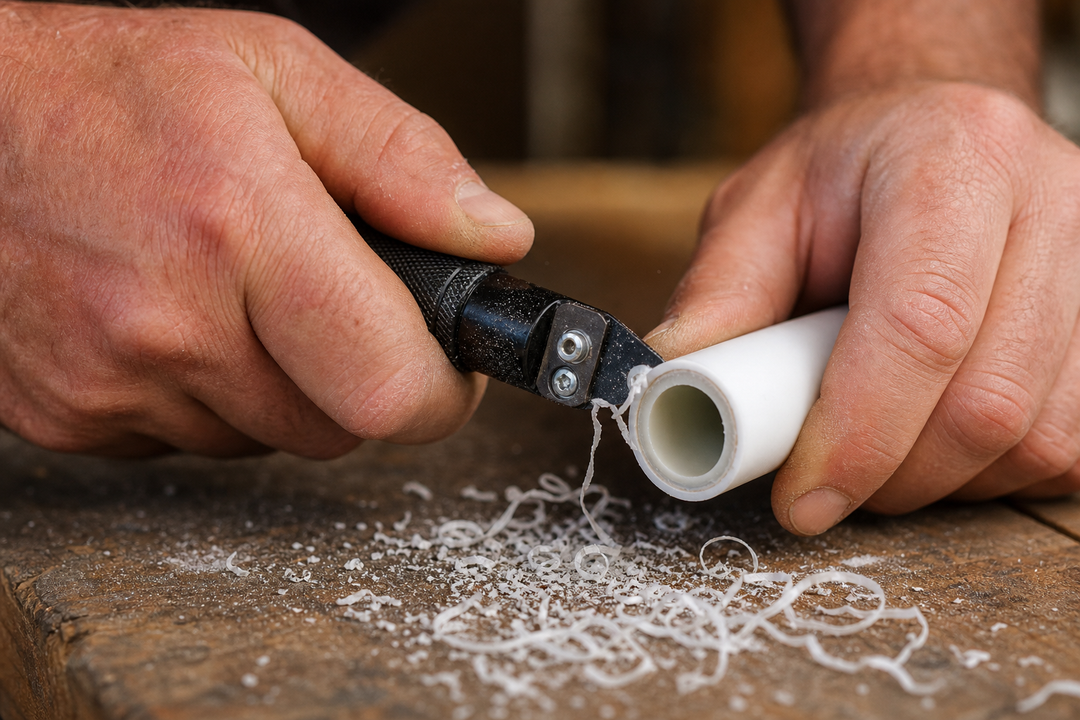
Bevel and insert
Cut the pipe square and bevel the end, then push it into the press adapter. Bevelling is mandatory. A raw cut edge will damage the O-ring on insertion.
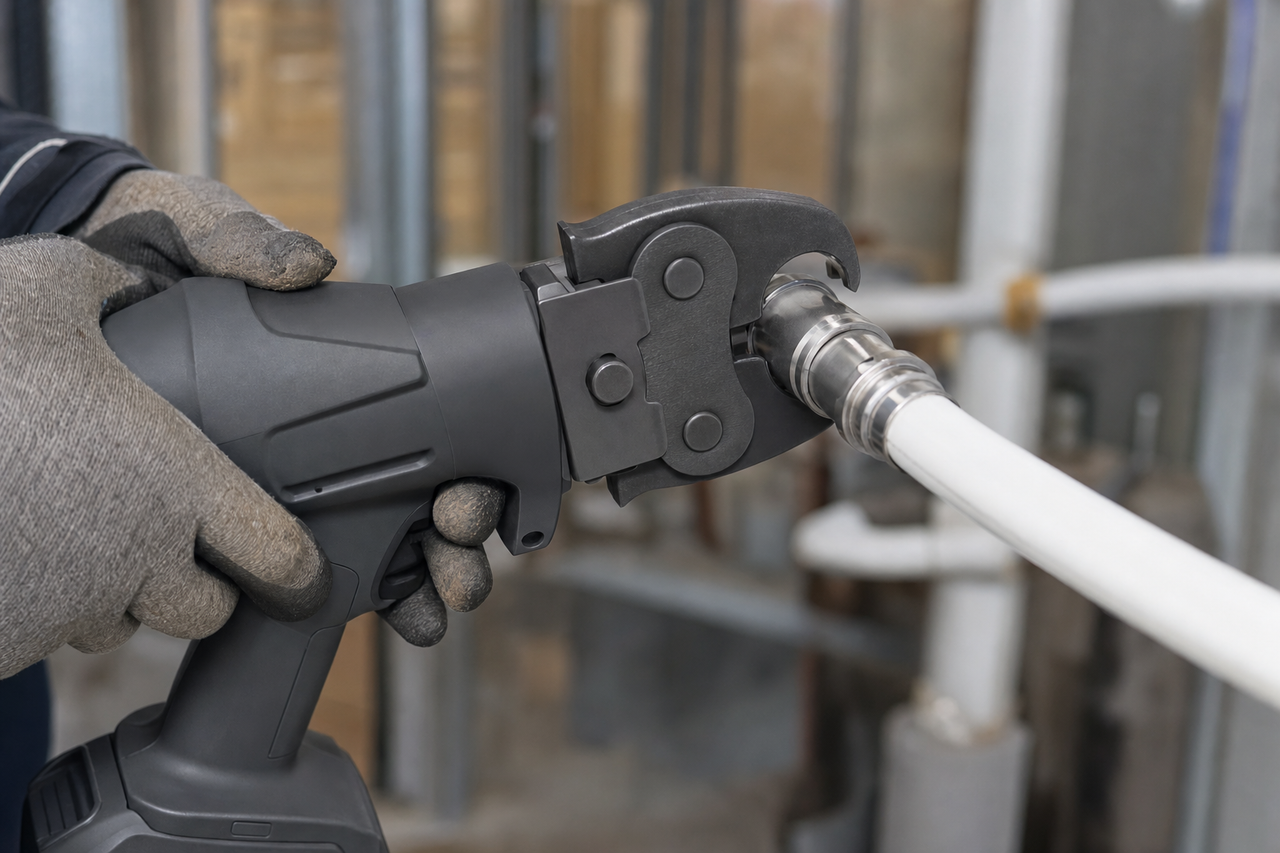
Press the adapter
Press the adapter onto the pipe at the workbench, jaw seated in the guide groove on the sleeve. Comfortable working height, no confined space, no overhead load.
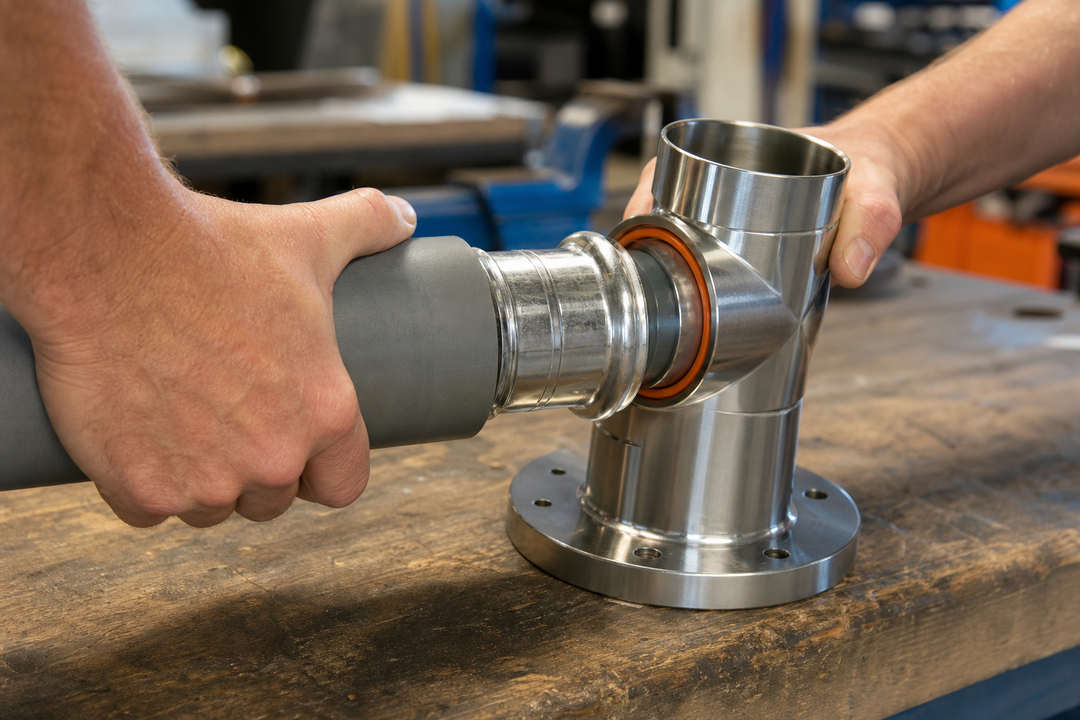
Insert into the base
Push the pressed adapter into the base element of the fitting. No tool, no heat, no torque setting, and the assembly is still adjustable at this point.
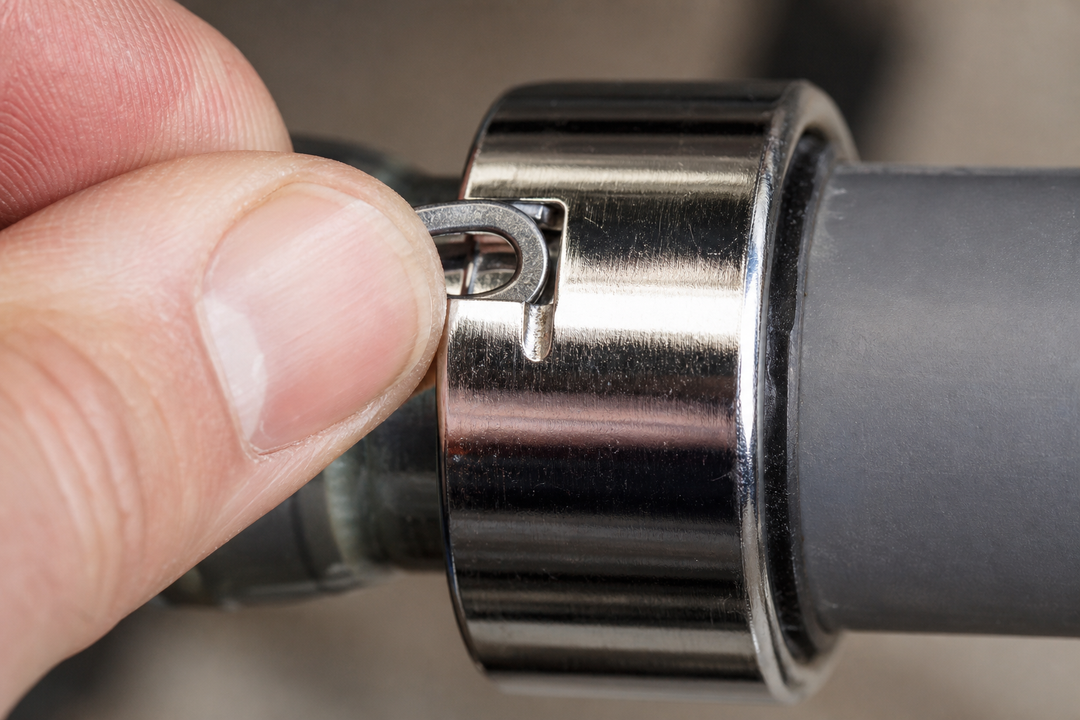
Lock
Push the locking element into the fitting opening until it clicks home. A locking pin is single-use: once released it must be replaced, not refitted.


- Rule 01 · Bending
Bending: 5 × OD by hand, tighter with a tool
Sizes 16 to 32 mm form by hand and hold their shape. A spring or bending tool takes the radius tighter; 40 to 63 mm needs a powered bender.
- Rule 02 · Expansion
Thermal expansion: plan the leg, fix the point
Rigid installation is not possible with composite pipe. The movement has to be either absorbed or controlled. Compensation always happens between two fixed points, across a change of direction.
- Rule 03 · Set-out
Set out by Z-dimension
Lines are measured centre to centre along the axial line, and the pipe length between two fittings is the centre distance less each fitting's Z-dimension (Lᵣ = Lᴳ − Z₁ − Z₂).
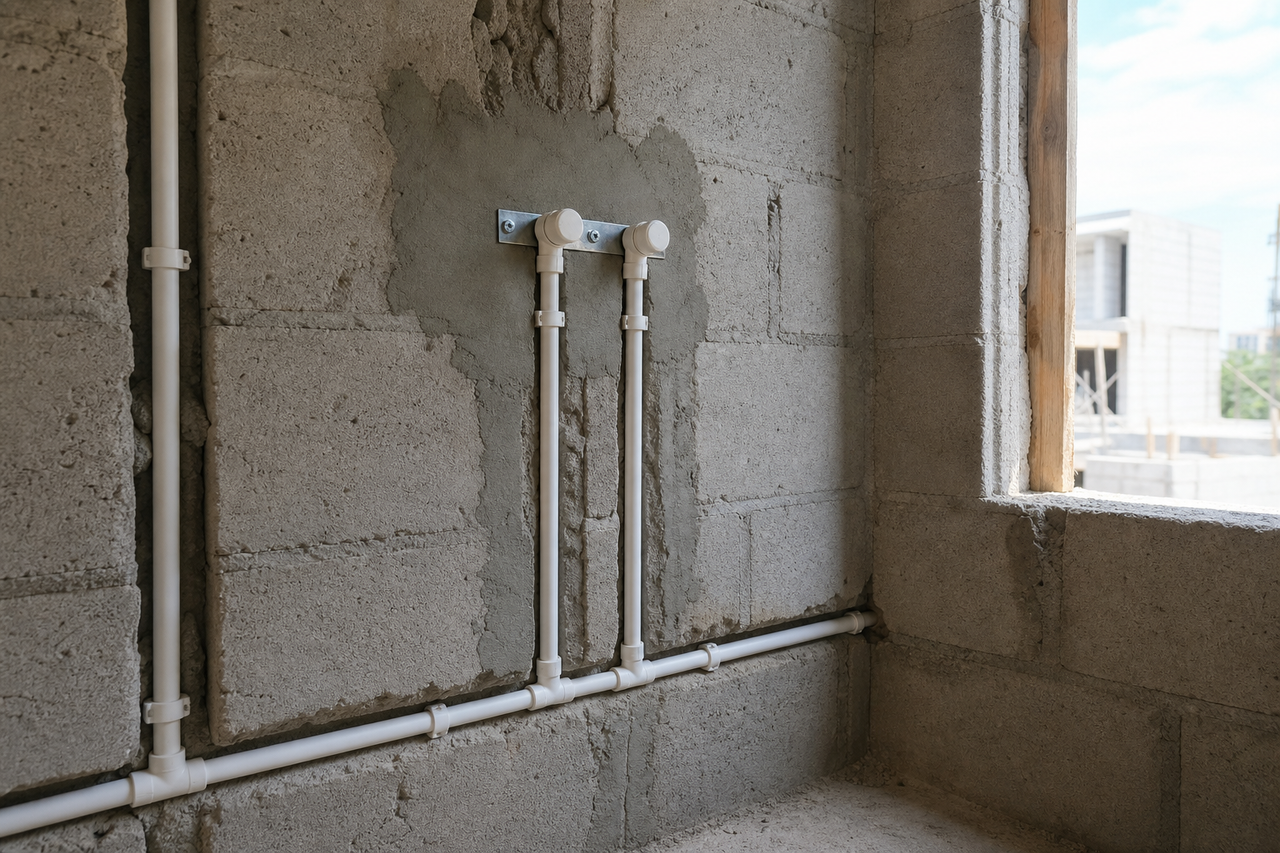


What Kuwait consultants and contractors ask us about composite pipe.
Straight answers to the questions that come up in project correspondence.
01What exactly is a multilayer composite (MLC) pipe?
A five-layer pipe. An aluminium tube is folded around and welded along its length with a safety overlap, then bonded by adhesive layers to an inner and outer skin of high-temperature-resistant polyethylene (PE-RT). The plastic gives you a corrosion-free bore and cold jointing; the aluminium gives you an oxygen barrier, low thermal expansion, and a pipe that stays where you bend it. It is also sold as PEX-AL-PEX or composite pipe, the same idea with the skins varying by manufacturer.
02How is MLC different from PEX?
Three practical differences. Composite holds its shape after bending where PEX springs back, so composite needs far fewer fixing points. Composite has a built-in oxygen barrier from the aluminium; PEX needs an added EVOH layer to achieve the same thing. And composite expands about a quarter as much as PEX for the same temperature change. PEX still wins on long coiled branch runs and on the very tightest bends. Many Kuwait projects use both: composite for risers and distribution, PEX for coiled branch work.
03Should we use MLC instead of PPR on a Kuwait project?
It depends on what drives the design, and PPR (PP-R) is still the right answer on plenty of jobs. Where composite wins: movement, because 50 m of PPR grows about 450 mm at Δt 50 K against 62.5 mm for composite, so the anchor and expansion-leg design is far simpler; oxygen, because PPR has no diffusion barrier and composite carries one in the aluminium core; and hot work, because PPR is heat-fused and composite is pressed cold, which removes the permit from riser shafts and occupied floors. Composite also carries more water at the same outside diameter, since the PPR wall is thicker. PPR keeps the advantage on rigid distribution, on sizes above 110 mm, and on material cost per metre. Send us the specification and we will comment on both.
04What sizes do you supply, and what is stocked?
Ten dimensions: 16×2, 20×2.25, 25×2.5, 32×3, 40×4, 50×4.5, 63×6, 75×7.5, 90×8.5, and 110×10 mm. Small sizes come coiled up to 500 m as well as in 5 m straight lengths; from 40 mm up it is straight lengths only. Press and composite fittings cover 16 to 50 mm, the modular riser system covers 63 to 110 mm, and compression fittings cover 16 to 25 mm. Send the take-off and we will confirm stock and lead time in writing.
05How are joints made, and do we need a hot work permit?
No permit is needed, because nothing is heated. Up to 50 mm, joints are pressed with a jaw: metal press fittings with a fixed sleeve, or PPSU composite fittings as the economy option. From 63 to 110 mm, the modular riser system is pressed at the bench, then inserted and locked in place by hand. Compression and eurocone fittings cover radiator and appliance tails. All four methods are cold, which is usually the deciding factor on occupied hotel and hospital floors.
06What documentation do you supply for consultant submittal?
The full pack for the make supplied on your project: manufacturer certification and approval certificates, declarations of conformity, material safety data sheets, technical and installation manuals, and pressure test documentation, packaged in the submittal format the specification calls for. Certification varies by manufacturer, so tell us the specification clause you need to satisfy and we will confirm before you order.
Send the take-off. Quoted within 24–48 hours.
Layout, sizes, and riser diameters are enough. We come back with a priced, stock-checked, submittal-ready package, pressing tools confirmed.
Supplied onKNPC Mina Abdullah RefineryJaber Al Ahmad HospitalShuwaikh Power PlantAll 11 Kuwait references

Get in touch
Quotes are returned within 24–48 hours.
Phone +965 2475 6717Email info@combinedcooperation.comOffice Office No. 8, 4th Floor, Mubarak Al Tijari Building, Farwaniya, Kuwait