

Fabricated bends and tees
Segmented 30°–90° bends and tees 140–1000 mm, sweep bends 110–630 mm and reducing tees to 1000/800 mm in the pipe's SDR class.
View detailsWhen a moulded fitting does not fit the layout, Combined Cooperation sources PE100 fabricated specials for Kuwait projects from drawings, BOQs and pipe schedules: segmented bends at 30°, 45°, 60° and 90° from 140 to 1000 mm, sweep bends from 110 to 630 mm, segmented tees, reducing tees to 1000/800 mm, long and short stub ends to 1000 mm, headers and manifolds, and PE-to-steel transitions — in SDR 17 (PN10) through SDR 7.4 (PN25) to match the pipe, packaged with the pipe, the electrofusion fittings and the fusion equipment.
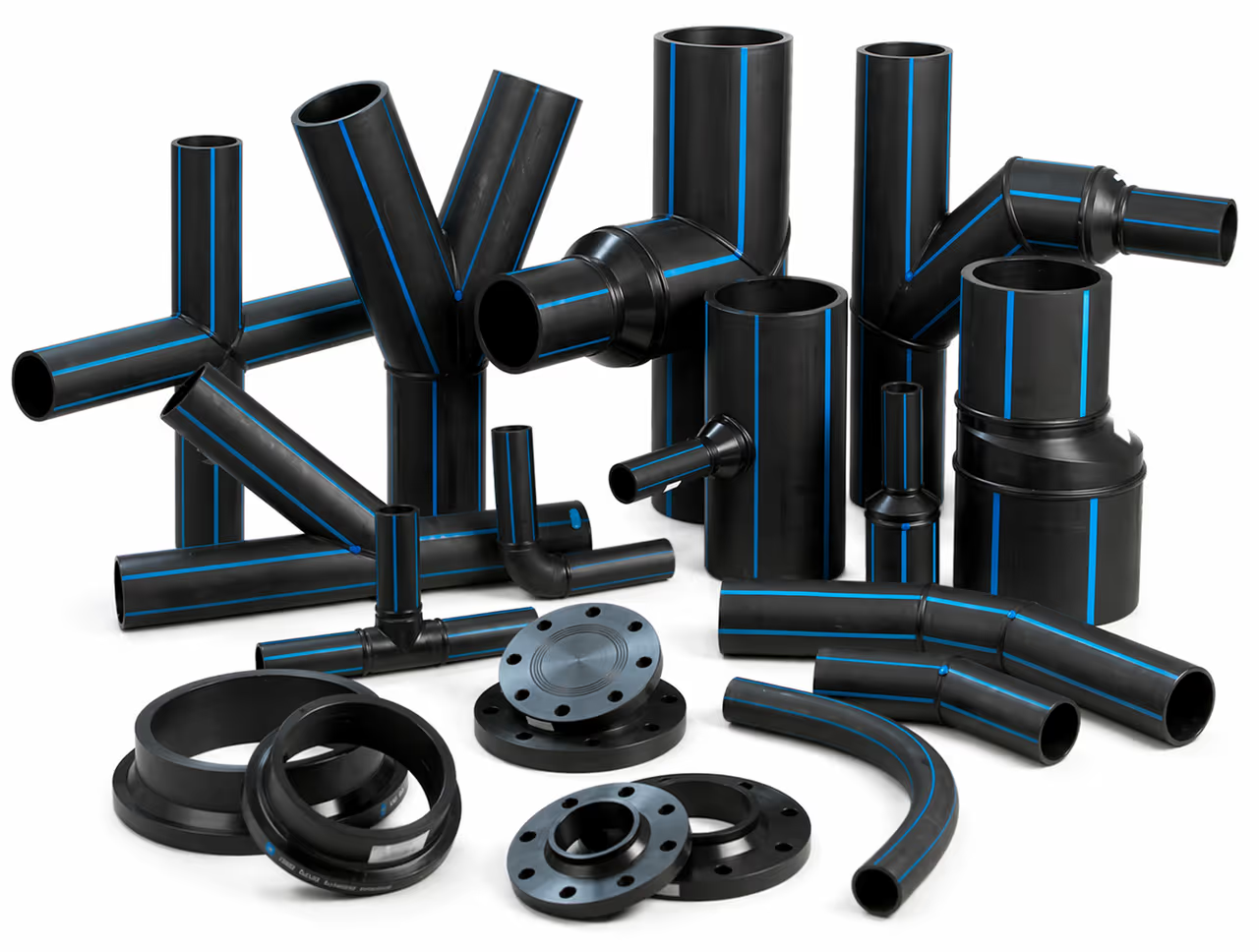
Fabricated HDPE specials in Kuwait cover segmented bends and tees from 140 mm to 1000 mm, sweep bends from 110 mm to 630 mm and reducing tees up to 1000/800 mm, all in PE100 and welded from the same pipe class as the line they join. Segmented fittings are supplied in PN6.3, PN10 and PN16 classes, which is why the operating pressure and temperature matter as much as the pipe size — send both with the drawing.
From the ELOFIT spigot and segmented range; larger or odd-angle items are built to drawing.
| Type | Angles / pattern | Size range (mm) | Class |
|---|---|---|---|
| Segmented bend | 30°, 45°, 60°, 90° | 140–1000 | PE100 PN6.3 / PN10 / PN16 |
| Segmented tee | 90° | 140–1000 | PE100 PN6.3 / PN10 / PN16 |
| Segmented tee | 45° | 140–500 | PE100 PN6.3 / PN10 / PN16 |
| Sweep bend | 11°, 22°, 30°, 45°, 60°, 90° | 110–630 | SDR 17 (S8) PN10 / SDR 11 (S5) PN16 |
| Reducing tee | Concentric | SDR 17: 90/50 – 1000/800; SDR 11: 63/32 – 630/500 | PN10 / PN16 |
| Stub end, short pattern | For backing flange | 110–1000 (SDR 17); 110–800 (SDR 11) | PN10 / PN16 |
| Reducer, short pattern | Concentric | 200/160 – 710/630 (SDR 17); 200/160 – 630/560 (SDR 11) | PN10 / PN16 |
| Headers and manifolds | To drawing | Any of the above sizes | Pipe class |
| Repair saddle (electrofusion) | Wrap-around | 75–1000 | For damaged pipe walls without cutting |
From the material data sheet in our HDPE piping catalogue.
| Property | PE100 | Test method |
|---|---|---|
| Density | 959 kg/m³ | ISO 1183 |
| Melt flow rate, 190 °C / 5 kg | 0.25 g/10 min | ISO 1133 |
| Tensile stress at yield | 25 MPa | ISO 527-2 |
| Elongation at break | > 600 % | ISO 527-2 |
| Tensile modulus | 900 MPa | ISO 527-2 |
| Charpy impact, notched, 0 °C | 16 kJ/m² | ISO 179/1eA |
| Hardness, Shore D | 60 | ISO 868 |
| Carbon black content | 2–2.5 % | ASTM D1603 |
| Brittleness temperature | < −70 °C | ASTM D746 |
| Linear thermal expansion | 2.0 × 10⁻⁴ per °C (0.2 mm/m·°C) | ASTM D696 |
| Thermal conductivity | 0.41 W/m·K | DIN 52612 |
| Minimum required strength (MRS) | 10.0 MPa | — |
For industrial specials on dosing, effluent and process lines. Check the medium against the full resistance list before fabrication.
| Medium | Concentration | Max. operating temperature |
|---|---|---|
| Sulphuric acid | 30 % | 60 °C |
| Hydrochloric acid | 20 % | 60 °C |
| Phosphoric acid | 85 % | 60 °C |
| Nitric acid | 30 % | 40 °C |
| Chromic acid | 20 % | 20 °C |
| Hydrofluoric acid | 40 % | 40 °C |
| Formic acid | 50 % | 40 °C |
| Caustic soda solution | 30 % | 60 °C |
| Acetone | Technical grade | 40 °C |
| Ethanol | 96 % | 60 °C |
Coefficient 0.2 mm per metre per °C — the number that decides anchors, guides and loops on above-ground headers.
| Temperature change | Length change per metre |
|---|---|
| 5 °C | 1 mm |
| 10 °C | 2 mm |
| 20 °C | 4 mm |
| 30 °C | 6 mm |
| 40 °C | 8 mm |
A 100 m above-ground header that sees a 40 °C swing between winter night and summer afternoon in Kuwait grows and shrinks by 80 mm — anchor and guide the specials to take it.
Segmented 30°–90° bends and tees 140–1000 mm, sweep bends 110–630 mm and reducing tees to 1000/800 mm in the pipe's SDR class.
View details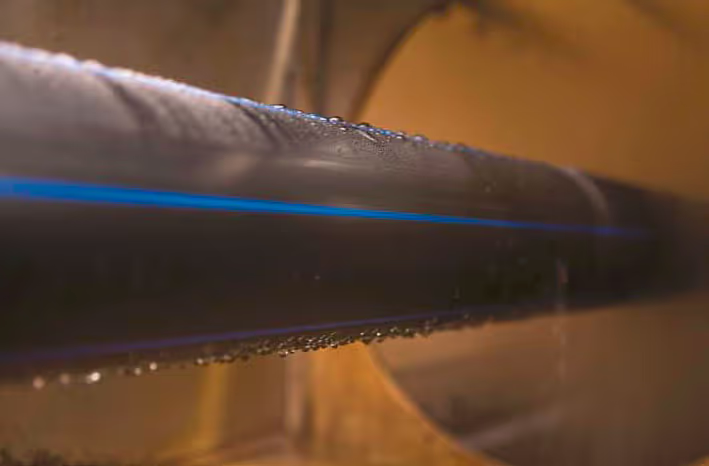
Pipe from 20 to 800 mm in SDR 11 and SDR 17, matched to the specials so the whole line carries one class.
View details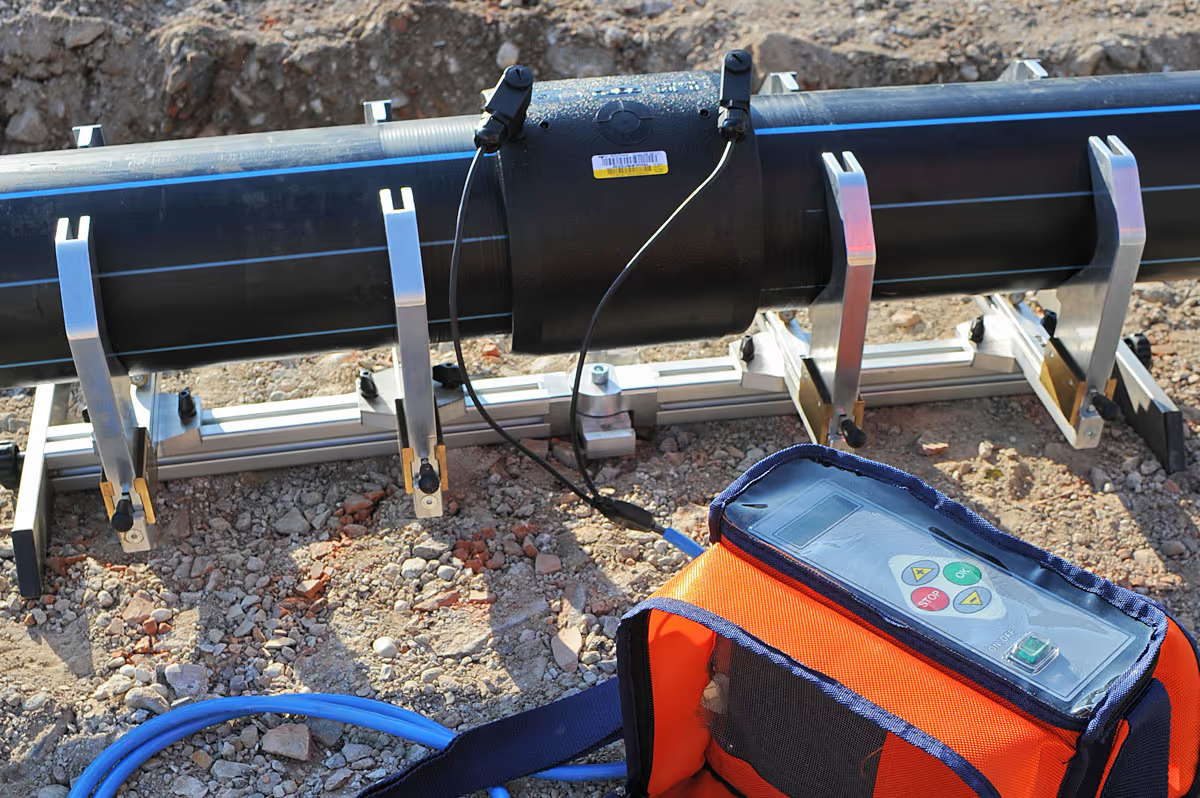
Couplers 20–1000 mm, repair saddles 75–1000 mm and top-load branch saddles to 630 mm for connecting the special into the live line.
View detailsMost custom fitting enquiries in Kuwait resolve into three either/or choices. This is how our team reads a drawing when it arrives, and what we need from you to price it.

Standard 45° and 90° elbows, equal tees, reducers and stub ends — no drawing needed, full moulded wall, quickest to supply.
Sizes above the moulded range, angles other than 45° and 90°, reducing tees to 1000/800 mm, offsets, headers and manifolds — built from pipe segments to your drawing.
If a moulded pattern exists in the size and class, we quote it first — it is cheaper and carries the full PN rating.

Large diameters and tight plantroom or chamber layouts where the bend has to be short — mitred segments butt-fused into the angle.

Pumped mains, TSE and irrigation lines where a smooth radius keeps head loss down and lets the line be pigged or swabbed.
Sweep bends keep the pipe's own SDR class (S8 for SDR 17, S5 for SDR 11); segmented bends are classed PN6.3, PN10 or PN16 — state the operating pressure.
Specials that sit inside a welded run — plain spigots for the butt machine, or for an electrofusion coupler where the ends are fixed.

Specials that bolt to valves, pumps, strainers or steel — a fused stub end with a loose backing flange on each leg that needs to come apart.
Mixed ends are normal: a header with spigot ends on the main and flanged branches for the valves. Mark each end on the drawing.
A sketch with the OD and SDR of every leg, the angles, the leg lengths from the centre line, the end preparation on each leg, and the orientation of branches is enough. Free-text descriptions of headers and offsets are where fabrication errors start.
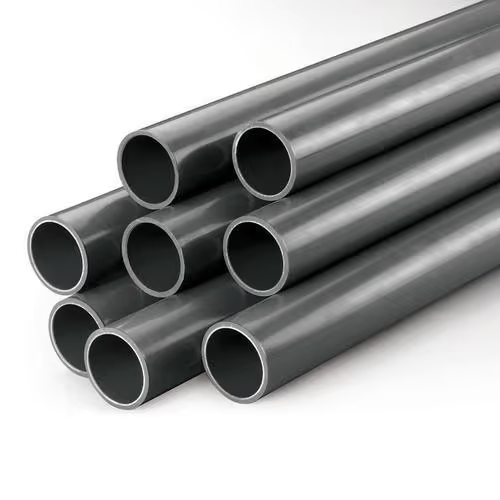
SDR 11 carries 16 bar at 20 °C but 11.5 bar at 40 °C over 50 years; SDR 17 falls from 10 to 7.3 bar. Give us the operating pressure and temperature and we pick the pipe class and segmented pattern that still clears the duty in a Kuwait summer.
Specials built from the same PE100 class as the pipe weld cleanly on the same machine. Quoting the pipe, the moulded fittings, the electrofusion tie-ins and the specials together keeps one class across the line and one submittal for the consultant.
Yes. Send the drawing or sketch with the OD and SDR of each leg, the angles and leg lengths, the end preparation on each leg, the medium with its operating pressure and temperature, the test pressure and the quantity, and we return a priced offer within 24–48 hours.
Segmented bends and 90° tees from 140 to 1000 mm, 45° segmented tees from 140 to 500 mm, sweep bends from 110 to 630 mm, reducing tees to 1000/800 mm in SDR 17 and 630/500 mm in SDR 11, and short-pattern stub ends to 1000 mm. Headers and manifolds are built from those same sizes.
Yes, within their class. Sweep bends keep the pipe's own class — SDR 17 for PN10 and SDR 11 for PN16 — while segmented bends and tees are supplied as PN6.3, PN10 or PN16 patterns. State the operating pressure and temperature so the pattern is chosen to clear the duty, and check hot lines against the temperature derating table.
A sweep bend where the line is pumped, pigged or swabbed and a smooth long radius matters — 110 to 630 mm in the pipe's SDR class. A segmented bend where space is tight, the diameter is large or the angle is not a standard one — 30°, 45°, 60° or 90° from 140 to 1000 mm, built from mitred pipe segments.
Yes. Any leg can end in a butt-fused stub end with a loose backing flange in PN10 or PN16 — aluminium, epoxy-coated steel, PP-coated cast iron or galvanized steel — so the special bolts to valves, pumps, strainers or steel flanges, while the other legs keep plain spigots for fusion into the run.
PE100 resists most process media: from our catalogue, 30 % sulphuric acid, 20 % hydrochloric acid, 85 % phosphoric acid and 30 % caustic soda are all handled to 60 °C, nitric acid and hydrofluoric acid to 40 °C. Send the medium and concentration and we check it against the full resistance list before fabrication.
Yes. Specials are quoted with PE100 pipe from 20 to 800 mm in SDR 11 and SDR 17, the moulded butt fusion fittings, the electrofusion couplers and saddles for tie-ins, and butt fusion or electrofusion machines where the site needs them, so the whole line arrives in one class and one submittal.
Share the BOQ, drawing, pipe size, pressure class, or product list and our team will respond with a coordinated offer.
