
Studor air admittance valves for drainage venting in Kuwait.
One-way vent valves that let air into the drainage system when a fixture discharges and close by gravity when the flow stops, so trap seals are protected and sewer gas stays in the pipe. The Studor range covers Mini-Vent, Tec-Vent, and Maxi-Vent air admittance valves (AAVs) for 1½″ to 4″ pipe, the P.A.P.A. positive air pressure attenuator for single stack drainage in multi-storey buildings, and the Maxi-Filtra carbon vent filter for odour control.
- Pipe sizes covered
- 1½″–4″
- Largest stack valve capacity
- 500 DFU
- Valve temperature rating
- −40 to 65 °C
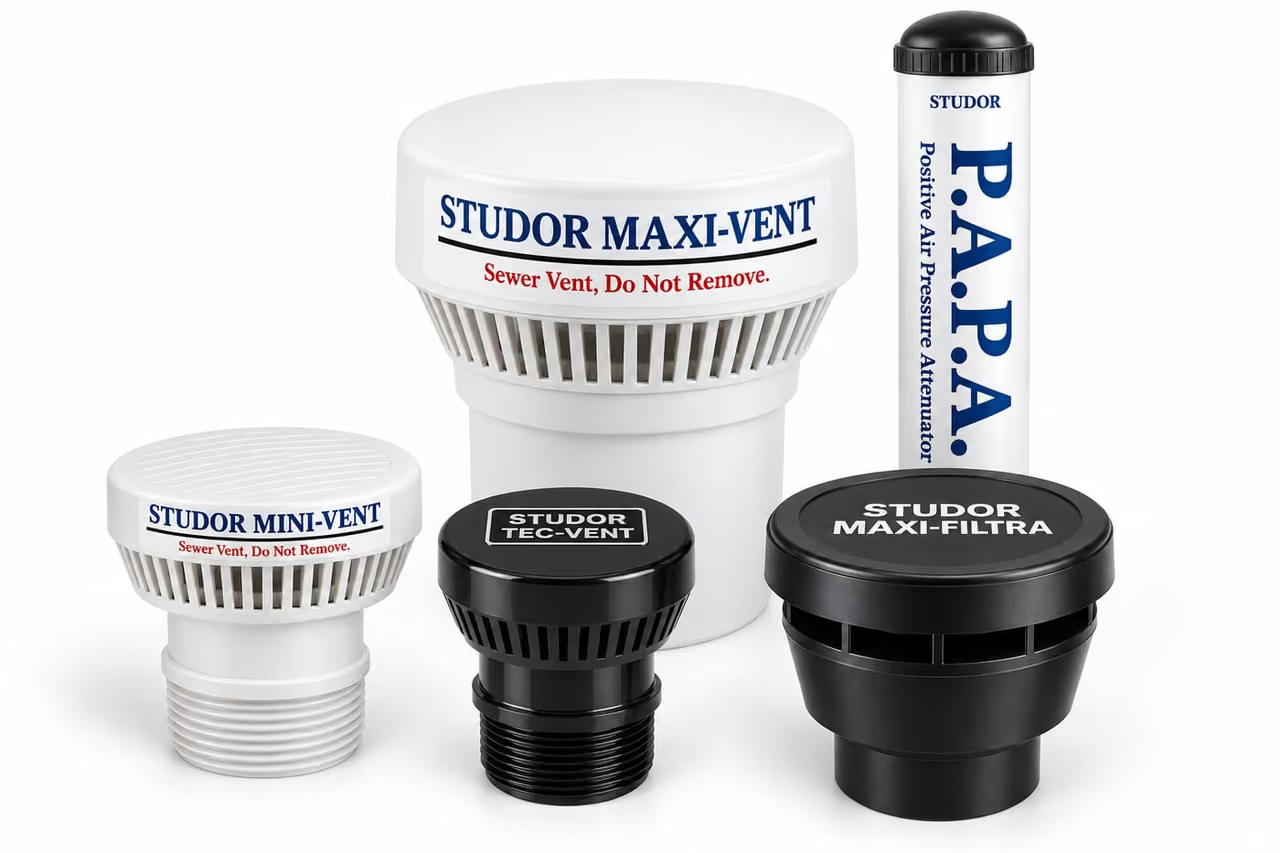
Studor valves, attenuator, and accessories for drainage venting.
Studor air admittance valves deal with negative pressure at the fixtures and the stack head. The P.A.P.A. attenuator deals with the positive pressure surges that a tall stack sends back up from its base.

Studor Mini-Vent, 1½″ and 2″
Branch air admittance valve in ABS for individual fixtures, bathroom groups, and horizontal branches. Threads into a 1½″ adaptor that fits 1½″ or 2″ pipe, and vents up to 160 DFU on a 4″ branch.- Individual, common, wet, circuit, and branch vents
- Insect screens inside and outside the seal
- Protective cover for outdoor installation

Studor Tec-Vent, 1½″
Flame-retardant air admittance valve, moulded in UV-stable polycarbonate for commercial buildings. 1½″ thread, the same capacity as the Mini-Vent, in a material rated UL 94 V-0.- Schools, hospitals, hotels, and airports
- Return-air plenums, where the project design and authority permit
- UV-stable for outdoor installation

Studor Maxi-Vent, 3″ and 4″
Stack air admittance valve in ABS for the head of a drainage stack or a 3″ or 4″ branch. A 3″ spigot with a 4″ push-fit connector, venting up to 500 DFU on a 4″ stack.- Stack vent, vent stack, or branch vent duty
- Insect screens inside and outside the seal
- Insulating cover and metal cap for rooftop use

Studor P.A.P.A. Positive Air Pressure Attenuator
A sealed vessel with an internal bladder that absorbs the positive pressure surge formed at the base of a multi-storey stack, in place of relief vent piping. 3″ spigot, rated 5 psi, up to four units in series.- Mounts vertically or horizontally off the stack
- No springs or compressed gas, no maintenance
- Works with air admittance valves or a conventional vent system

Studor Maxi-Filtra Carbon Vent Filter, 3″ and 4″
A two-way carbon vent filter for outdoor vent terminals. It passes air in both directions through an activated carbon cartridge and removes drain odour at open vent pipes, septic tanks, and lift stations. It is a filter, not an air admittance valve.- Replacement cartridges supplied separately
- Cartridge life of up to two years
- UV-stable body, 3″ spigot with 4″ push-fit connector

Studor Aluminium Cover for Maxi-Vent
A metal cap that fits over the Maxi-Vent and its insulating cover on a roof, shielding the valve from direct sun and extreme temperature. 175 mm diameter, 92 mm high.- Fixed to the insulating cover with adhesive tape
- Can be painted to match the roof finish before fitting
Sized by drainage fixture units, specified by performance standard.
Each valve is selected from the pipe size it sits on and the fixture load it vents. Share the drainage schedule and we match the valve type and quantity, then issue the datasheets and submittal documents with the quote.
Request technical support- Valve standards
- ASSE 1051 (fixture and branch) / ASSE 1050 (stack)
- Attenuator standard
- ASSE 1030, positive pressure reduction devices
- Sizes
- 1½″ / 2″ / 3″ / 4″ pipe
- Materials
- ABS / Flame-retardant polycarbonate
- Temperature
- −40 °C to +65 °C
- Connections
- 1½″ threaded adaptor / 3″ spigot / 4″ push-fit
- Brand
- Studor: Mini-Vent / Tec-Vent / Maxi-Vent / Maxi-Filtra / P.A.P.A.
- Listings
- ASSE Seal of Approval / IAPMO / ICC-ES PMG-1025 / NSF 14 / ETL
- Support
- Valve schedule from drawings / Submittal documents
Where a drainage vent valve replaces vent pipework.
They remove vent pipework that is hard to route and roof penetrations that have to be weathered, and they put the air supply next to the fixture that needs it.


How Studor air admittance valves are installed.
A valve has one moving part and no springs. Site problems come from where it was put, so each detail below leads with the dimension that matters.
One stack instead of two.
A conventional drainage riser runs a second stack only to carry air, with a vent pipe from every fixture group. Valves at the branches and an attenuator at the base do the same job on the drain stack alone.
- Drainage pipe
- Vent pipe
- Air admittance valve
- Positive air pressure attenuator


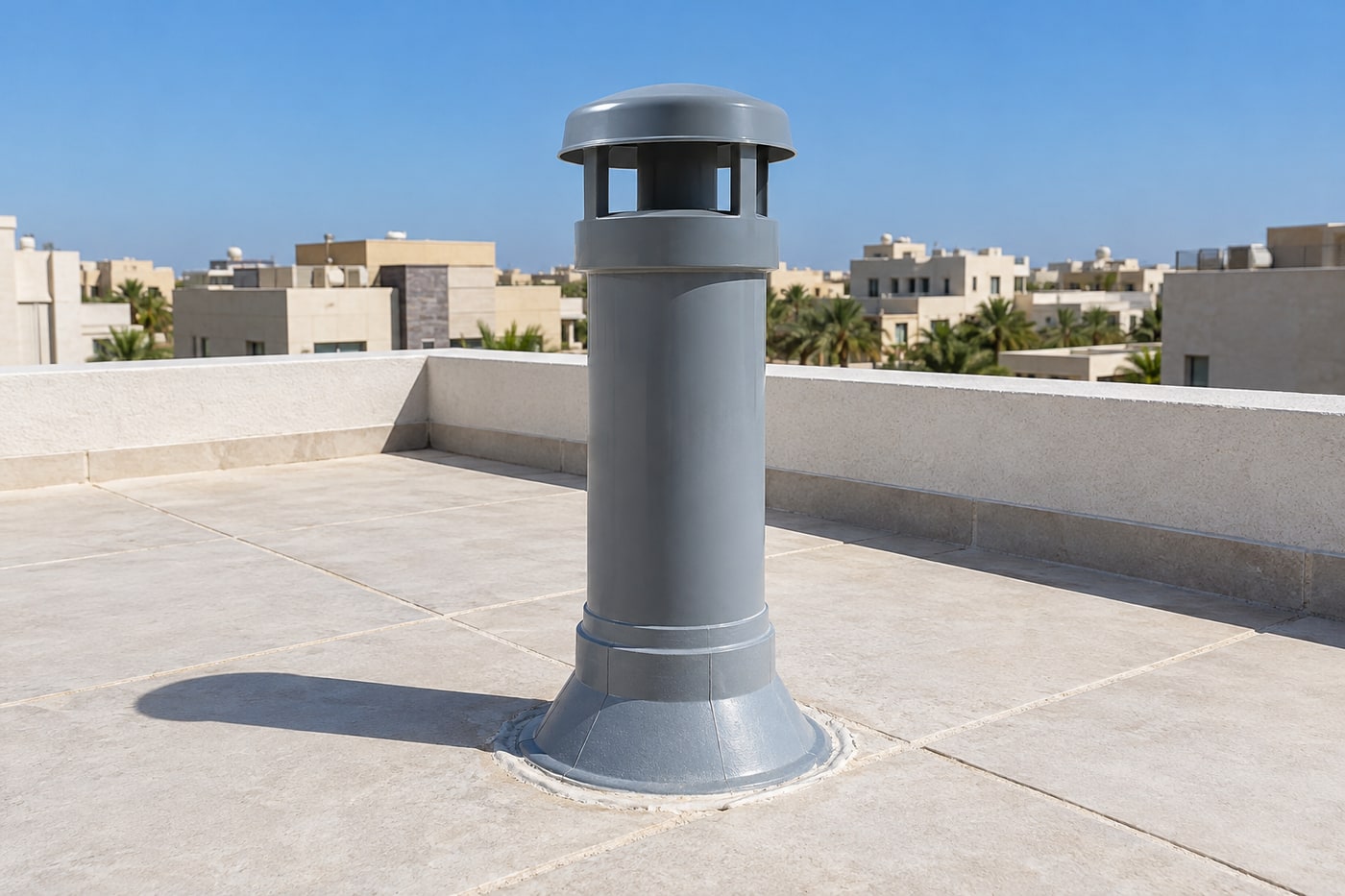
1 open vent per building
One vent stays open
Every building drainage system keeps at least one stack vent or vent stack open to the outside air. It relieves positive pressure, which a valve cannot do.
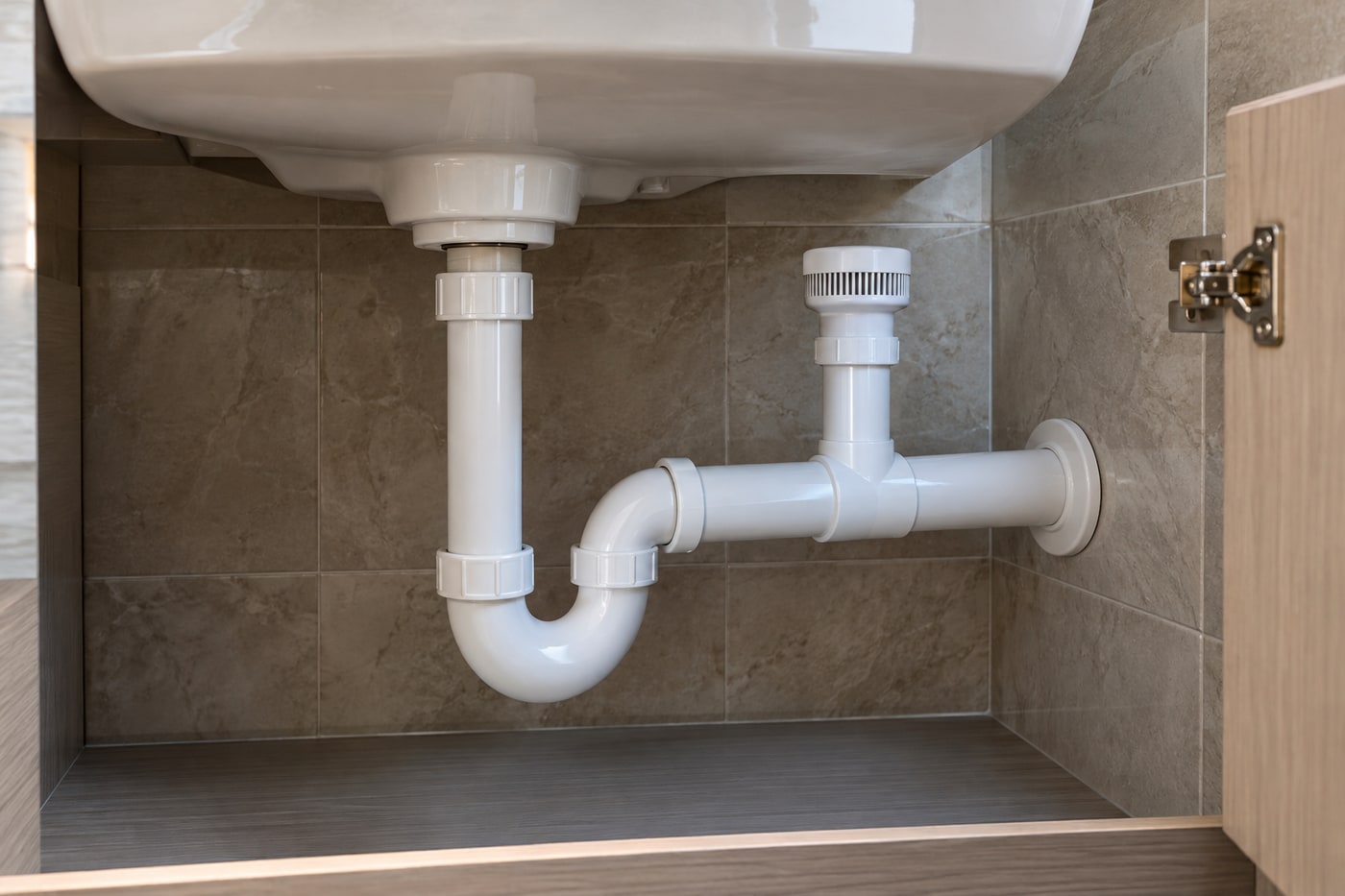
100 mm above the branch
Above the pipe it vents
Set the valve at least 100 mm above the horizontal branch or fixture drain. It can sit below the flood rim of the fixture.
- Upright, within 15° of vertical
- Sink and vanity cabinets are acceptable locations
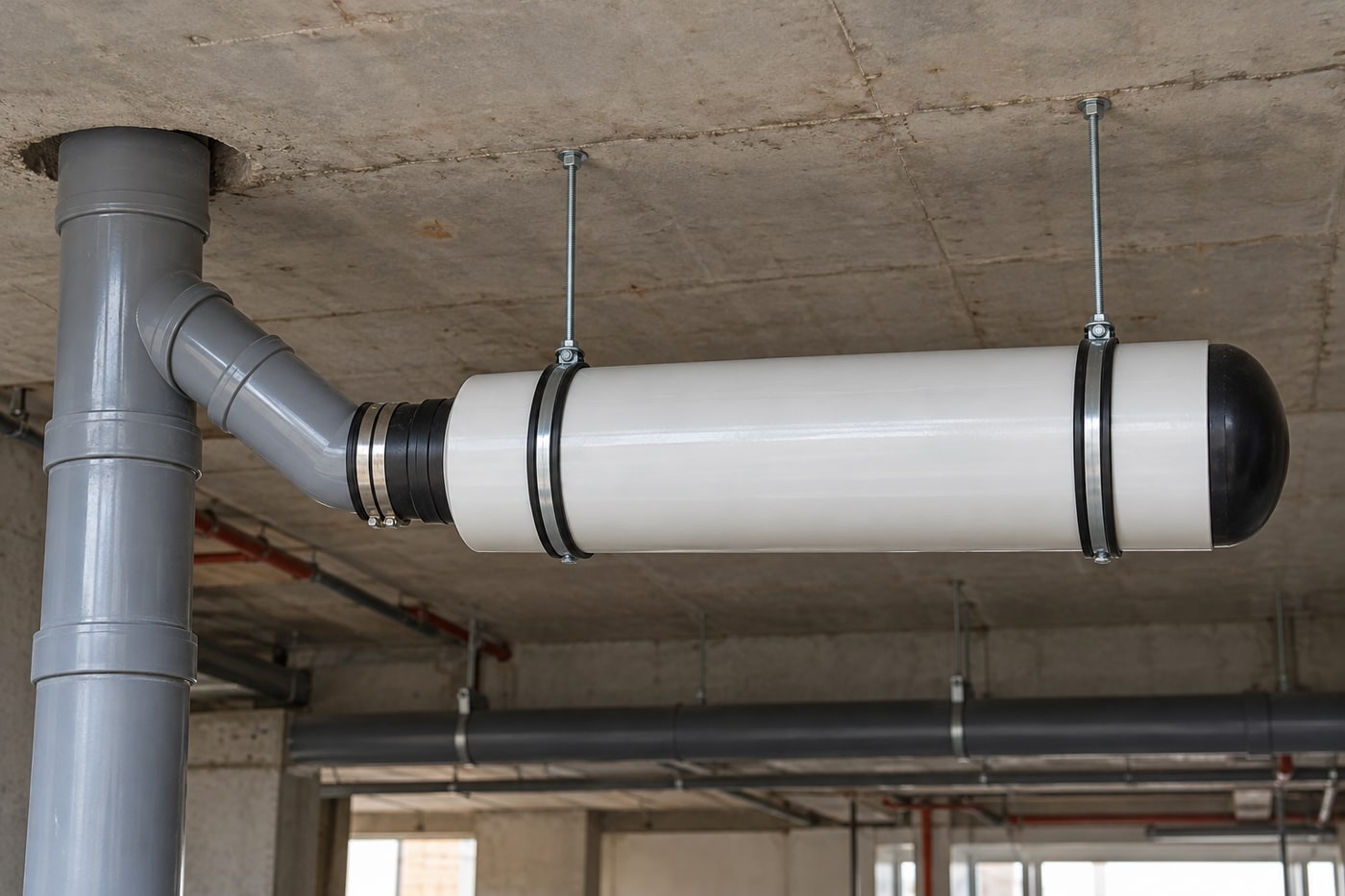
3 m maximum from the stack
P.A.P.A. attenuator off the stack
The attenuator connects to a branch fitting off the vertical stack and mounts vertically or horizontally, no more than 3 m from the stack.
- Support it on its own rubber-lined bracket
- Join it with a no-hub or flexible coupling
- Give a horizontal unit a slight fall so it drains
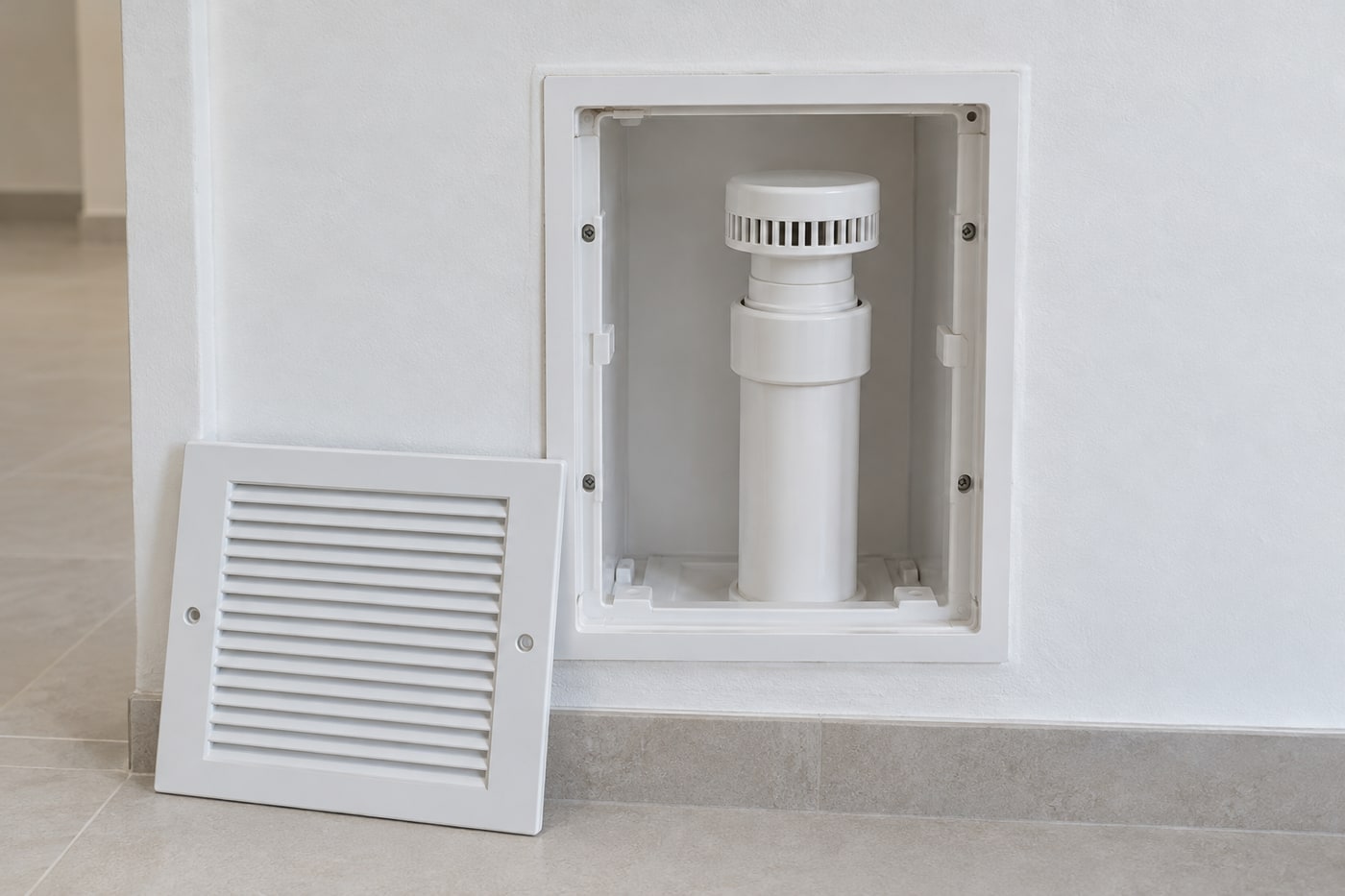
Access for replacement
Valves stay within reach
A valve in a wall goes in a recessed box behind a louvred grille. The grille gives access and lets the valve draw air.
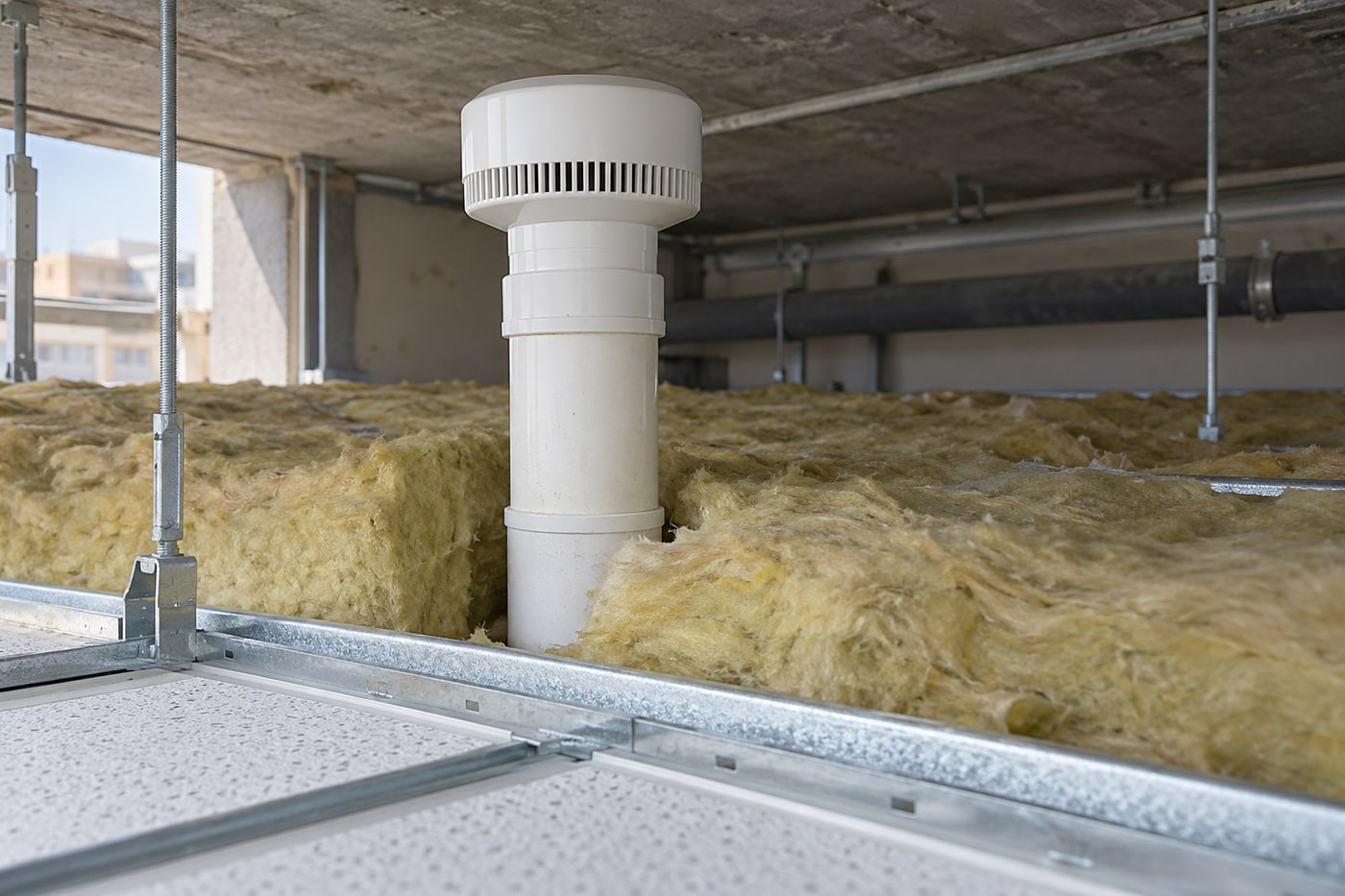
150 mm above insulation
Roof and ceiling voids
In a void, the valve stands at least 150 mm clear of the insulation. A Maxi-Vent also sits 150 mm above the highest fixture flood rim it serves.
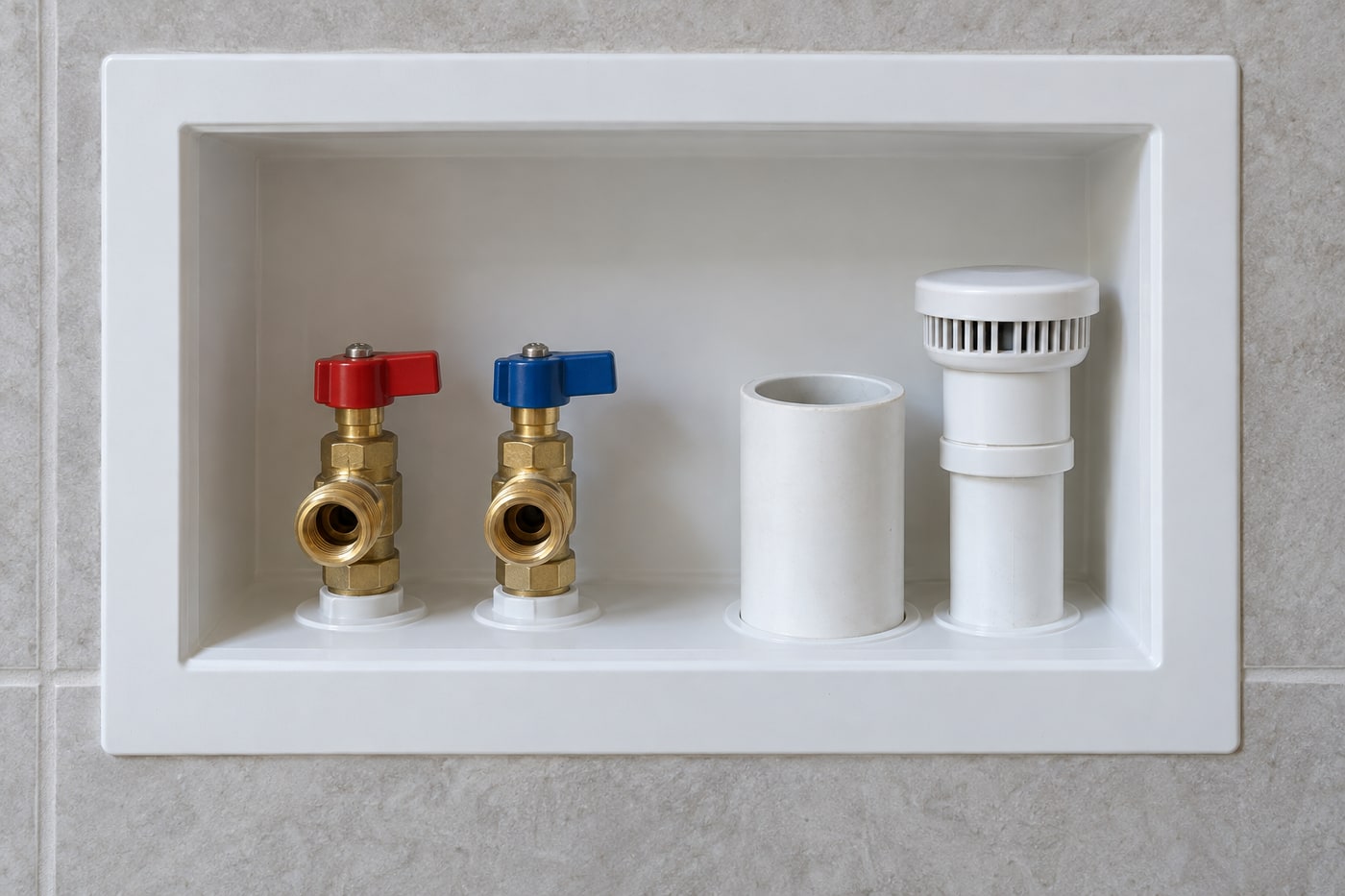
In the box with its adaptor
Washing machine outlets
A Mini-Vent fits inside a dual-drain washing machine outlet box. Its adaptor makes the joint, and the vent stays in the wall and within reach.
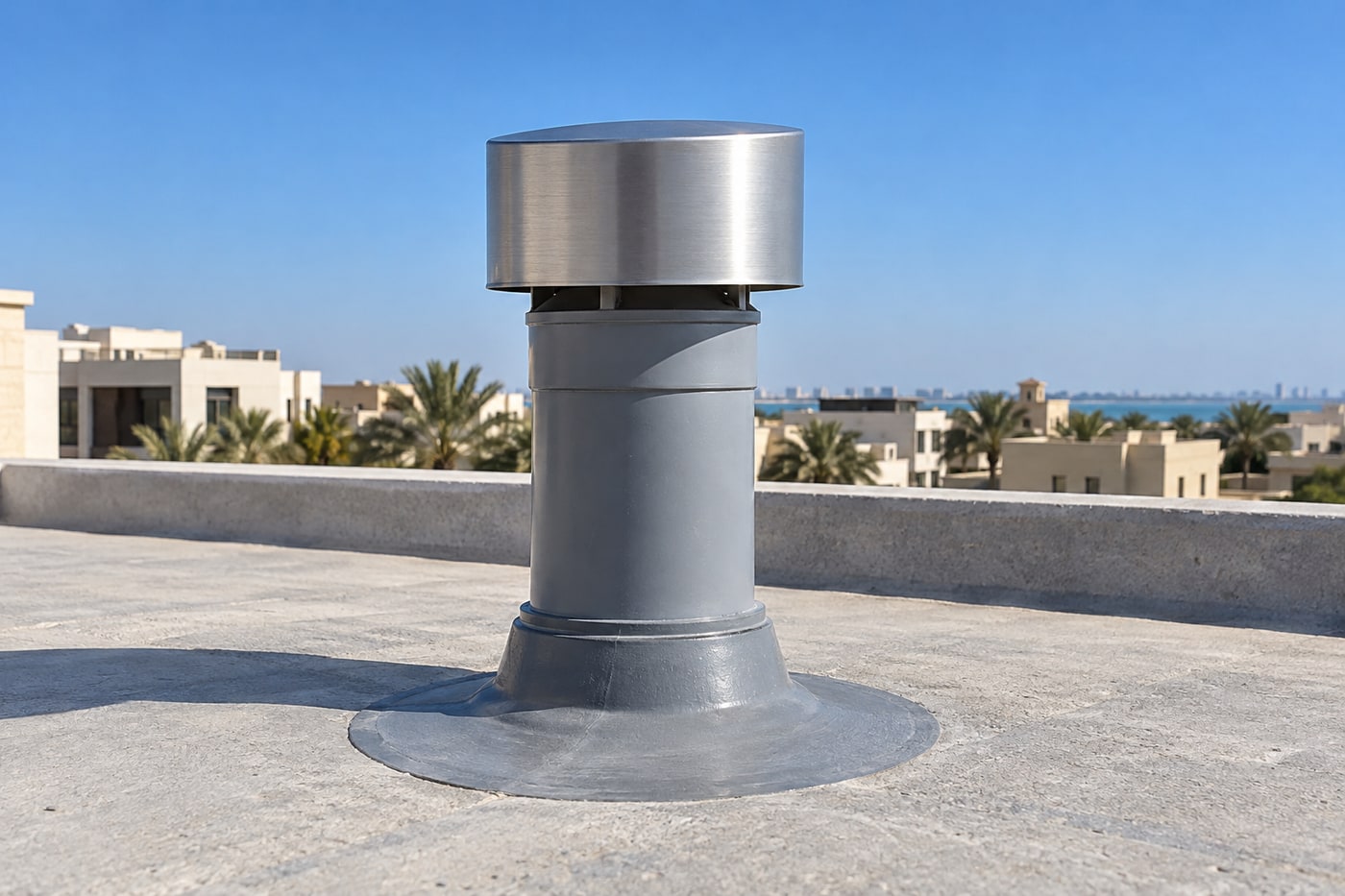
Covered on the roof
Outdoor valves
On a roof, the Maxi-Vent takes an insulating cover and an aluminium cap against sun and heat. The Mini-Vent has its own protective cover.


Four rules at the fitting stage
- Fit valves at second fix, after the drainage pressure test.
- PTFE tape only on the threads. No primer, solvent cement, or jointing compound.
- A stack valve on its own vents a stack of up to six branch intervals.
- No connection between the attenuator and the base of the stack.
Acceptance of air admittance valves varies by authority and consultant. Confirm it for the project before the venting design is fixed.
Common air admittance valve questions.
Short answers for teams specifying or buying drainage vent valves.
01Do you supply Studor air admittance valves in Kuwait?
Yes. We supply the Studor Mini-Vent, Tec-Vent, Maxi-Vent, Maxi-Filtra, and P.A.P.A. attenuator in Kuwait, quoted within 24–48 hours.
02What does an air admittance valve do?
It opens when a discharging fixture creates negative pressure in the drain, letting air in so the trap seal is not siphoned. It closes by gravity when the flow stops, which keeps sewer gas out of the room.
03Can air admittance valves replace the roof vent completely?
No. A valve only admits air, so every building drainage system keeps at least one vent open to atmosphere to relieve positive pressure.
04How many fixtures can one valve vent?
It depends on the pipe size and the drainage fixture unit load: from 3 DFU for a Mini-Vent on a 1½″ branch up to 500 DFU for a Maxi-Vent on a 4″ stack. Send the fixture schedule and we will confirm the valve.
05What does a positive air pressure attenuator do that a valve cannot?
It absorbs the positive pressure surge that discharge creates at the base of a multi-storey stack. A valve closes under positive pressure, so it cannot relieve it.
06Is an air admittance valve the same as an automatic air vent?
No. An air admittance valve vents a drainage system, while automatic air vents release air from chilled and hot water pipework and are a separate range.
Send the drainage schedule and we'll quote.
Share the riser diagram or fixture schedule and we'll return a valve and attenuator list with pricing within 24–48 hours.

Get in touch
Quotes are returned within 24–48 hours.
Phone +965 2475 6717Email info@combinedcooperation.comOffice Office No. 8, 4th Floor, Mubarak Al Tijari Building, Farwaniya, Kuwait