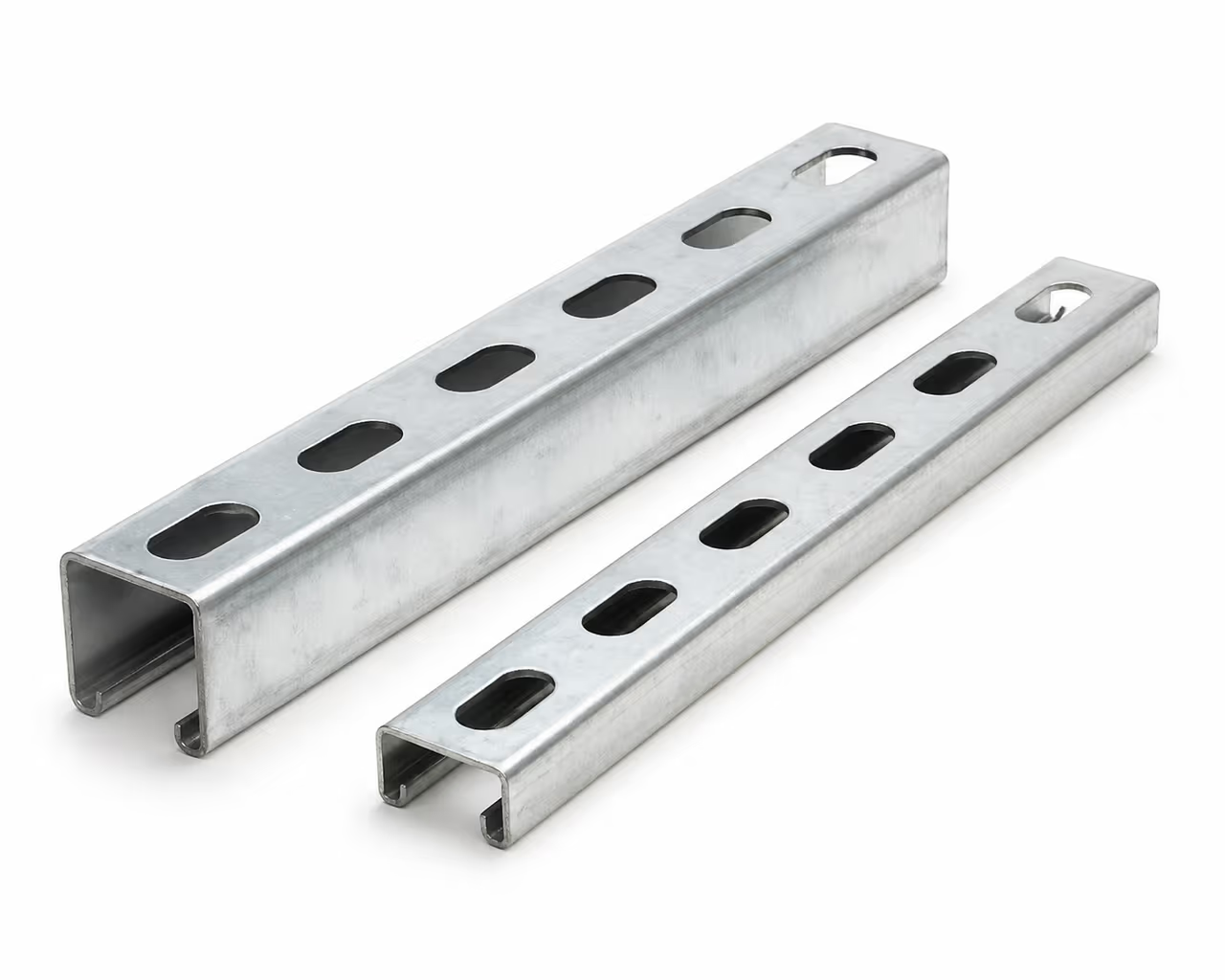
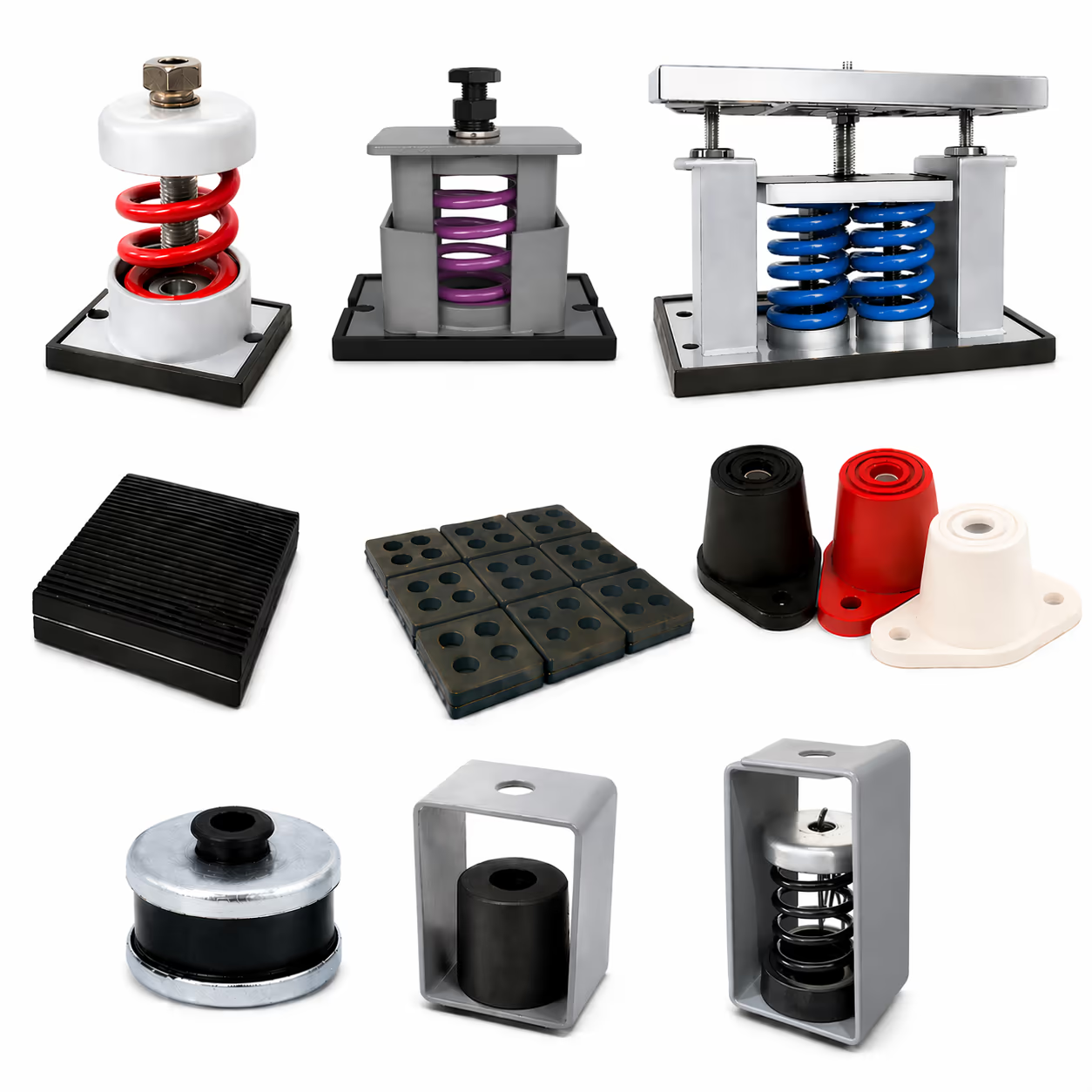
A chiller, a pump set, or an air handling unit bolted straight to a slab turns the building into a loudspeaker: the hum reaches the rooms around the plant room and the pipework carries it up the risers. Vibration isolators break that path — but only if the isolator suits the machine’s weight and speed, the base it sits on, and the structure underneath. This guide covers how spring mounts, pads, hangers, and concrete inertia bases are selected for chillers, pumps, and AHUs, using the TEMBO datasheets we supply from in Kuwait and ship to Oman and the wider GCC.
What a plant-room isolator is for
Rotating and reciprocating machines produce force at their running speed: an impeller slightly out of balance, a compressor stroke, a belt, a fan wheel. Rigidly mounted, that force goes straight into the slab, and concrete carries it a long way. That is why a basement pump can be heard in a ground-floor office and a rooftop chiller felt in a top-floor bedroom.
An isolator is a deliberately soft element between machine and structure. On the right spring, the structure sees a small fraction of the force. On the wrong one, the system can resonate and transmit more than a rigid mount would. Three things decide which: the static deflection of the isolator under load, the base the machine sits on, and the flanking paths — pipes and ducts — that carry vibration around the isolators. The vibration isolators range covers all three.
Static deflection and machine speed
When a machine is lowered onto spring mounts, the springs compress. That compression is the static deflection, and it sets the natural frequency of the mounted system: the more a spring deflects, the lower the frequency. A widely published rule of thumb puts natural frequency in hertz at roughly 15.8 divided by the square root of the deflection in millimetres — about 3.2 Hz for a 25 mm spring and 2.2 Hz for a 50 mm spring.
Isolation only starts once the running frequency is well above that figure. The general rule is that below about 1.4 times the natural frequency the mount amplifies rather than isolates, and useful isolation needs a ratio of three or more. A pump at 1,500 rpm runs at 25 Hz, which a 25 mm spring handles comfortably. A slow fan or compressor at a few hundred rpm is where the 50 mm spring earns its place. The TEMBO open spring mount datasheet tabulates theoretical isolation efficiency for three deflections:
| Machine speed | 15 mm deflection | 25 mm deflection | 50 mm deflection |
|---|---|---|---|
| 300 rpm | Do not use | 34.0% | 75.2% |
| 500 rpm | 68.7% | 83.3% | 92.3% |
| 1,000 rpm | 93.7% | 96.3% | 98.2% |
| 1,500 rpm | 97.3% | 98.4% | 99.2% |
| 2,000 rpm | 98.5% | 99.1% | 99.5% |
Those figures assume an infinitely stiff structure. Real slabs deflect, and a long-span roof slab far more than a slab on grade — which is why selection guides ask for more deflection as the span grows. The selection guide in the noise and vibration control chapter of the ASHRAE Handbook — HVAC Applications recommends isolator type, base type, and minimum static deflection by equipment type, power, speed, and floor span, and consultant specifications in Kuwait commonly reference it. Where the specification states a deflection, that figure governs.
A spring that is too stiff for a slow machine does not just isolate less. Near resonance, it transmits more than a rigid mount would.
Isolator type by equipment
The usual starting point for a Kuwait or Oman plant room. The specification, the floor, and what sits directly below decide the final choice.
| Equipment | Usual isolator | Base | TEMBO series |
|---|---|---|---|
| Air-cooled or water-cooled chiller | Closed (housed) or open spring mounts at each mounting point | Direct to the chiller frame; inertia base for reciprocating compressors or where specified | TGCSM0, TGOSM0 |
| Base-mounted end-suction or split-case pump | Open spring mounts | Concrete inertia base | TGIB00 with TGOSM0 |
| Belt-driven pump, reciprocating compressor, DG set | Open spring mounts | Concrete inertia base | TGIB00 with TGOSM0 |
| Floor-mounted AHU or centrifugal fan | Spring mounts; pads on light, higher-speed units at grade | The unit’s own base frame | TGOSM0, TGCSM0, TGAVP0 |
| Ceiling-hung AHU, FCU, or fan | Spring hangers; rubber hangers for light point loads | None — the isolator sits in the hanger rod | TGSPH0, TGRH00 |
| Rooftop packaged or condensing unit | Spring mounts over occupied floors; ribbed or waffle pads where demand is lower | Direct, or the unit’s own frame | TGOSM0, TGCSM0, TGAVP0 |
| First few pipe supports leaving the plant | Spring or rubber hangers; spring mounts under floor supports | — | TGSPH0, TGRH00, TGCSM0 |
Chillers
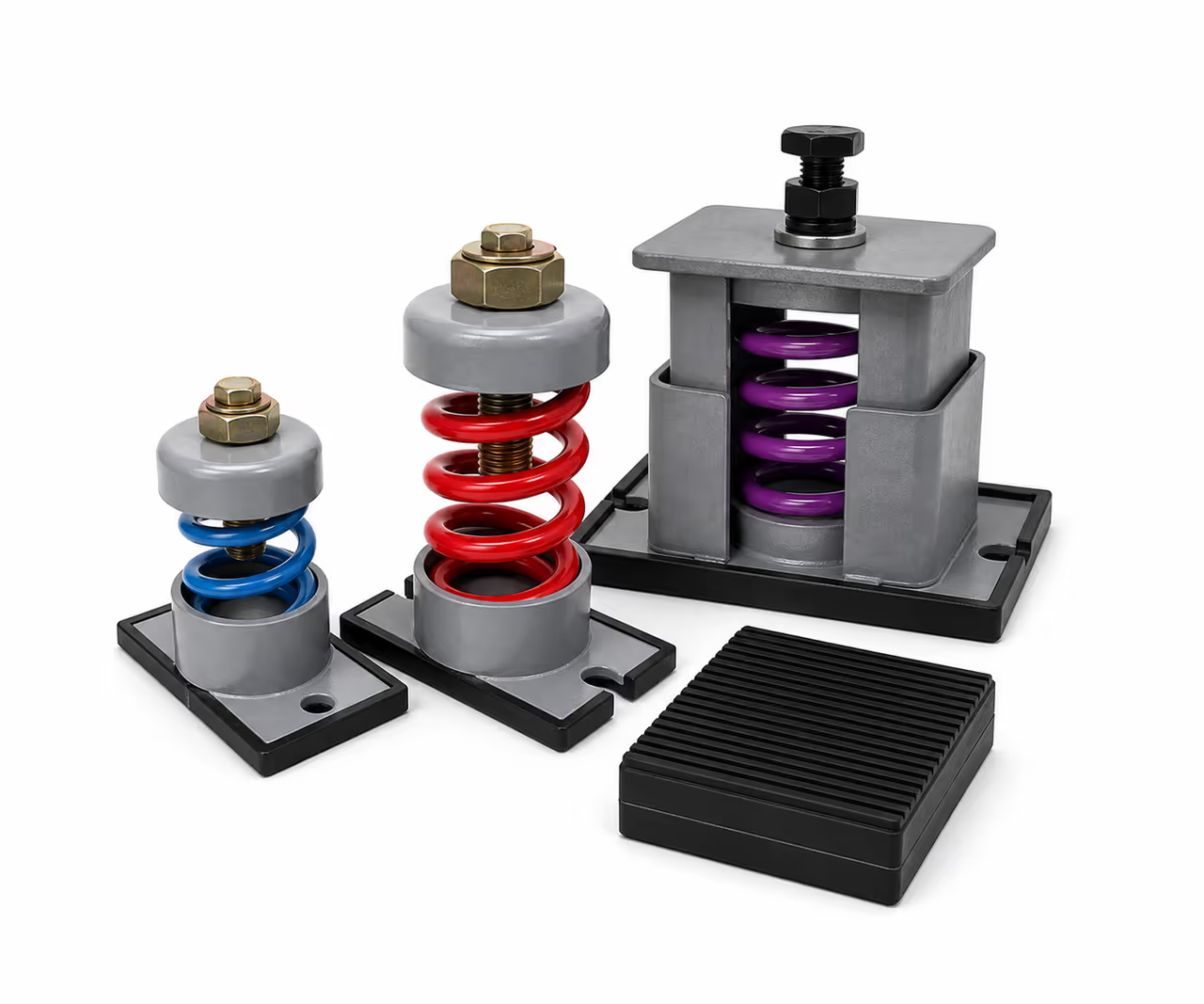
Chiller vibration isolators are selected per mounting point, not on total weight divided by the number of feet. The compressor end, condenser, and water charge sit in different places, so the manufacturer’s point-load schedule at operating weight is the document that matters. TEMBO springs are colour-coded by load rating, so the installer can see the right spring is under the right corner.
The closed spring mount (TGCSM0) is the usual chiller spring isolator: four models and 26 load ranges up to 5,000 kg, all at 25 mm deflection at rated load. Rubber snubbers inside the housing limit lateral movement at start-up, shut-down, and under horizontal wind load, and prevent the metal-to-metal contact that would short-circuit the isolator. Neoprene inserts below the springs and a 6 mm ribbed base pad break the high-frequency path. The full range is on the floor-mounted vibration isolators page.
Pumps
A close-coupled inline pump hung in the pipework is isolated through the supports around it. A base-mounted pump is different: motor and pump share a baseplate, their alignment matters, and the set has to resist the forces at start-up and at its pipe connections. That is why a pump on springs normally sits on a concrete inertia base. Belt-driven pumps are the strongest case, because belt tension adds a side load to an already unbalanced machine.
AHUs and fans
Floor-standing AHUs and fans usually go on spring mounts under their own base frame. Suspended units go on spring hangers (TGSPH0): a colour-coded spring in series with a moulded elastomeric element, 25 mm deflection, rated from 10 to 1,250 kg per hanger. Where the fan is slow, the deflection has to follow it. The ceiling-suspended isolator range covers spring hangers, rubber hangers, and duct mounts.
Spring, rubber, or an inertia base
Most plant-room selections come down to one of four answers, set side by side here using the TEMBO ranges.
| Option | Deflection (TEMBO range) | Works best on | Watch for |
|---|---|---|---|
| Anti-vibration pads (TGAVP0): ribbed, waffle, cork sandwich, metal sandwich | Low; ribbed pads can be layered to add deflection | Smaller, higher-speed equipment, slab-on-grade locations, and as a high-frequency noise break | Too little deflection for slow machines or plant over occupied floors |
| Rubber hanger (TGRH00) or duct mount (TGDM00) | 8–10 mm (hanger); 4 mm (duct mount) | Light suspended loads: up to 120 kg per point on the hanger, 50 or 100 kg on the duct mount | Not a substitute for a spring on heavier or slower equipment |
| Spring mount or hanger (TGCSM0, TGOSM0, TGSPH0) | 25 mm (closed, open, hanger); 50 mm (open mount) | Chillers, pumps, AHUs, fans, and rooftop plant over occupied space | Select on point load; never overload the rated spring |
| Concrete inertia base on open spring mounts (TGIB00) | 25 or 50 mm springs, plus added mass | Base-mounted and belt-driven pumps, reciprocating compressors, DG sets | Plinth size, even load across the mounts, and headroom |
Rubber and cork stop the high-frequency, audible range that a bare steel spring passes through its coils. That is why the TEMBO spring products pair the spring with an elastomer: inserts and a ribbed pad on the closed mount, integral rubber on the open mount, a moulded element on the hanger. Pads are the reverse case — good at high frequencies, limited at low ones. The cork sandwich pad gives the highest sound attenuation of the range; the metal sandwich pad, with a bonded steel plate, is designed for very high load capacity. All four come in squares from 3″ to 18″.
Concrete inertia bases for pumps
A spring alone cannot steady a machine that generates large unbalanced forces: it rocks on its mounts and the pipe connections flex at every start. A concrete inertia base adds mass. The TEMBO TGIB00 is a fully welded steel frame with reinforcement fixed 40 mm above the frame bottom; it is set on spring mounts, filled with concrete on site, and the pump and motor bolt to it. The extra weight lowers the centre of gravity, reduces motion, and improves low-frequency isolation.

Design rules from the datasheet
- Frame depth. 150, 200, 300, or 350 mm, and never less than one-twelfth of the longest side (L/12).
- Springs. Recessed corner brackets take TGOSM open spring mounts. Six or more isolators are recommended on exceptionally large bases.
- Load distribution. Spread the equipment load evenly across the mountings, with nothing overhanging the frame.
- Plinth. A concrete plinth should be at least 200 mm larger than the base in every direction, or 300 mm where snubbers are installed.
- Connections. Every connection needs a flexible section, and the pipework must be supported independently.
- Size. Standard sizes are catalogued; custom sizes are made to order against the pump and motor drawing.
Lateral stability, wind, and seismic restraint
A spring is soft sideways as well as vertically. A machine on bare springs can drift at start-up, rock at shut-down, and move under wind on an open roof. The closed mount’s housing and snubbers guide the top casing and limit that movement; TEMBO specifies an upper-to-lower housing clearance of 6 to 12 mm once adjusted. The open mount has no snubbing, which gives maximum isolation efficiency, and suits an inertia base, where the mass provides the stability.
Seismic restraint is a separate question. Where a specification calls for seismically restrained isolators, the restraint is an engineered item designed to the project’s seismic criteria, not a feature of a standard mount. Include that clause in the enquiry so the selection starts from the right requirement.
Pipe connections and the first supports
An isolated machine connected by rigid pipe is not isolated: the pipe becomes a second, stiffer mount. Two items close that path.
- Flexible connectors at every connection. TEMBO flexible pipe connectors use a nylon-cord reinforced neoprene/EPDM bellows. The triangular-flange type works to 20 bar; the union type to 17 bar with a 700 mm Hg vacuum rating for pump suction. Both run from −15 to +115 °C, and a stainless braided range covers higher ratings.
- Isolated supports leaving the machine. TEMBO’s guidance is to isolate the first few pipe supports leading from isolated equipment, so vibration does not bypass the mounts.
A connector is not a hanger; the pipe either side needs its own support. The FCU and plantroom version of this hookup, with dielectric unions and air vents, is in the FCU and plantroom hookup guide.
Kuwait and Oman: roofs, heat, and shipping
A large share of the cooling plant in both countries sits on roofs, directly above the top occupied floor, often on a long-span slab. That is where isolation matters most, and rooftop plant over occupied space normally goes on springs, selected with the slab in mind. Outdoor mounts also sit in the sun for months: TEMBO springs are powder coated, metal parts zinc plated, and the closed mount encloses the spring. State the exposure in the enquiry so mount type and finish can be checked.
Combined Cooperation supplies the range across Kuwait and ships spring mounts, hangers, pads, inertia bases, and flexible connectors to projects in Oman and the wider GCC. The selection is the same wherever the plant is: any vibration isolator supplier in Oman or Kuwait should be asking for the equipment schedule before quoting a single mount.
What to send for a selection
A mount cannot be selected from a unit count. For a priced offer within 24–48 hours, send:
- Equipment make and model from the approved schedule.
- Operating weight and the point load at each mount — the manufacturer’s weight distribution for chillers and AHUs, static and operating weight for pumps.
- Motor power and running speed in rpm.
- Number and position of mounting points, or the suspension drawing for hung equipment.
- Location — ground, basement, or roof — and what is directly below.
- Required deflection or isolator type, plus any seismic or wind restraint clause.
- For inertia bases: outside dimensions, plinth details, and any height limit.
- Pipe connection sizes and end types for the flexible connectors.
Send the schedule and specification through the contact page. The technical desk will return TEMBO codes by mounting point, flag any line where the specified deflection and machine speed disagree, and price it.
Frequently asked questions
What vibration isolators do chillers need?
Most chillers sit on spring mounts at each mounting point, selected on the manufacturer’s point load at operating weight. Closed (housed) spring mounts are the usual choice because the housing and rubber snubbers limit lateral movement at start-up, shut-down, and under wind. The TEMBO closed mount carries up to 5,000 kg per mount at 25 mm deflection, and the pipe connections need flexible connectors.
When does a pump need a concrete inertia base?
When it produces unbalanced forces that would make it rock on springs alone. Base-mounted and belt-driven pumps normally sit on a concrete inertia base carried on open spring mounts, which adds mass, lowers the centre of gravity, and holds pump and motor in alignment. TEMBO frames are 150 to 350 mm deep and never less than one-twelfth of the longest side.
Should I specify 25 mm or 50 mm spring deflection?
Follow the specification first. Without one, machine speed and floor decide it: a 25 mm spring isolates well at typical pump and fan speeds, while slow machines and plant on long-span or upper-floor slabs need more. The TEMBO datasheet gives 34.0% theoretical efficiency at 300 rpm for a 25 mm spring against 75.2% for a 50 mm spring.
Spring isolators or rubber pads — which should I use?
Springs for heavier or slower equipment and for any plant over occupied space. Pads suit smaller, higher-speed equipment and slab-on-grade locations, and they stop high-frequency noise that a bare spring passes, which is why TEMBO spring mounts and hangers include an elastomer element.
Do you supply spring mounts and vibration isolators in Oman?
Yes. Combined Cooperation supplies Kuwait and ships spring mounts, spring hangers, anti-vibration pads, concrete inertia bases, and flexible connectors to projects in Oman and the wider GCC. Send the equipment schedule and specification through the contact page for a priced offer within 24–48 hours.
What information do you need to quote vibration isolators?
Equipment make and model, operating weight and point load at each mount, motor power and running speed, the number of mounting points, the location and what is below it, and the specified deflection or isolator type. For inertia bases, add the outside dimensions, plinth details, and any height limit.
Send the equipment schedule with operating weights, running speeds, mounting points, and the specified deflection. The technical desk returns the matching TEMBO mounts, hangers, or inertia bases, priced within 24–48 hours, for Kuwait or Oman.
Also useful:Floor-mounted spring isolatorsConcrete inertia basesFlexible pipe connectors