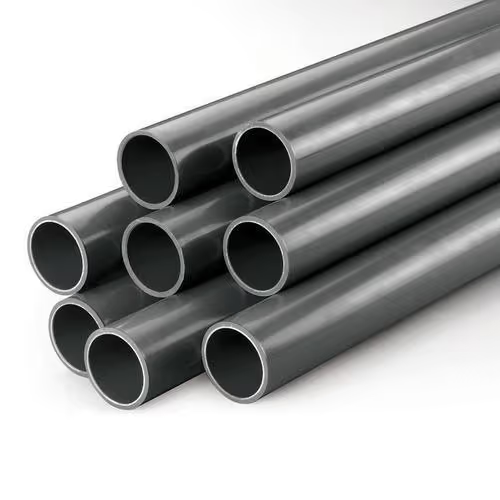
Butt fusion and electrofusion are not really competing technologies — they are two ways of doing the same thing. Both methods melt PE100 to PE100 and produce a joint that is stronger than the parent pipe. The interesting question is never which method is ‘better’. It is which method belongs on which run, on which day, on which site. This guide is a working comparison for consultants and contractors specifying HDPE for water, gas, sewage, and industrial pressure networks in Kuwait.
What ‘fusion’ actually does to HDPE
HDPE pipe to PE100 is a semi-crystalline thermoplastic. When two clean PE100 surfaces are pressed together at the right temperature for the right time, the polymer chains across the interface diffuse into each other and re-crystallise as one continuous structure. The interface disappears. The joint is not glued, sealed, or clamped — it is the same material as the pipe.
That is the only thing the two methods have in common. The heat source, the clamping, the operator skill, and the way the joint is recorded are different enough that the two methods behave like different systems on a project schedule.
Butt fusion — how the joint is made
Butt fusion welds two pipe ends directly to each other. Both ends are clamped in a fusion machine that aligns them axially, faces them with a rotating planer to produce two perfectly square surfaces, and then heats them against a flat heater plate held at 210 °C. After the soak time the heater is withdrawn and the two molten ends are pressed together under a controlled force until the weld cools and the bead is formed.
The whole sequence is governed by an international standard — ISO 21307 — which sets the temperature, soak time, fusion pressure, and cooling time for each pipe size and SDR class. On a modern machine the operator selects the pipe parameters and the controller runs the cycle automatically, logging temperature and pressure against the standard’s envelope.

The output is a continuous run of pipe. There is no fitting in the joint, just a small visible bead on the inside and outside of the pipe wall. That bead is the only physical evidence the joint exists, which is why butt fusion runs look like a single length of pipe even when they are 600 metres of welded sections.
Where butt fusion shows its strengths
- Cost per joint drops as the pipe gets bigger. No fittings are consumed at each weld — only operator time and electrical input. On a 300 mm trunk main the per-joint cost of butt fusion is a fraction of the equivalent electrofusion coupler.
- Continuous mainline output. Long straight runs of large-bore water main, brine line, or compressed air can be welded into one continuous string on the side of the trench and then lowered in.
- Auditable cycle data. A modern machine writes a weld log per joint — pipe size, SDR, ambient temperature, soak time, fusion pressure, cooling time, operator ID. That log is what the consultant inspects on the submittal pack.
Electrofusion — how the joint is made
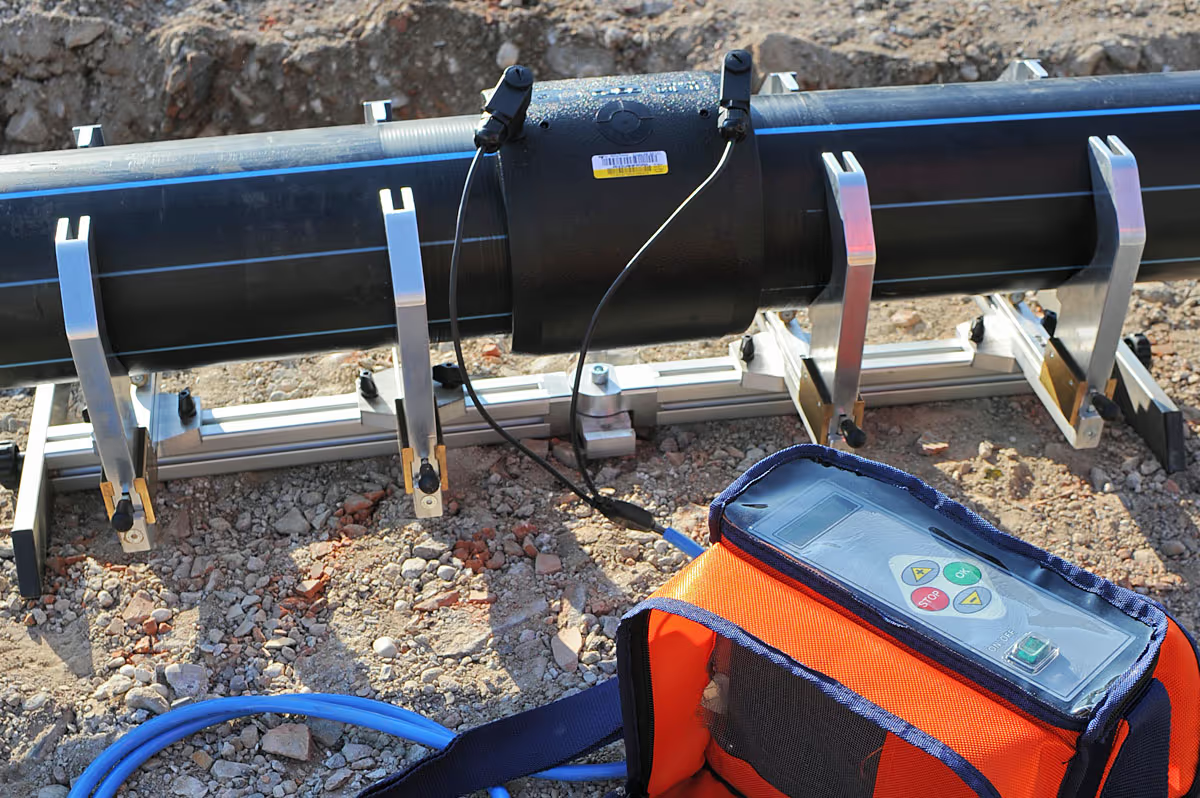
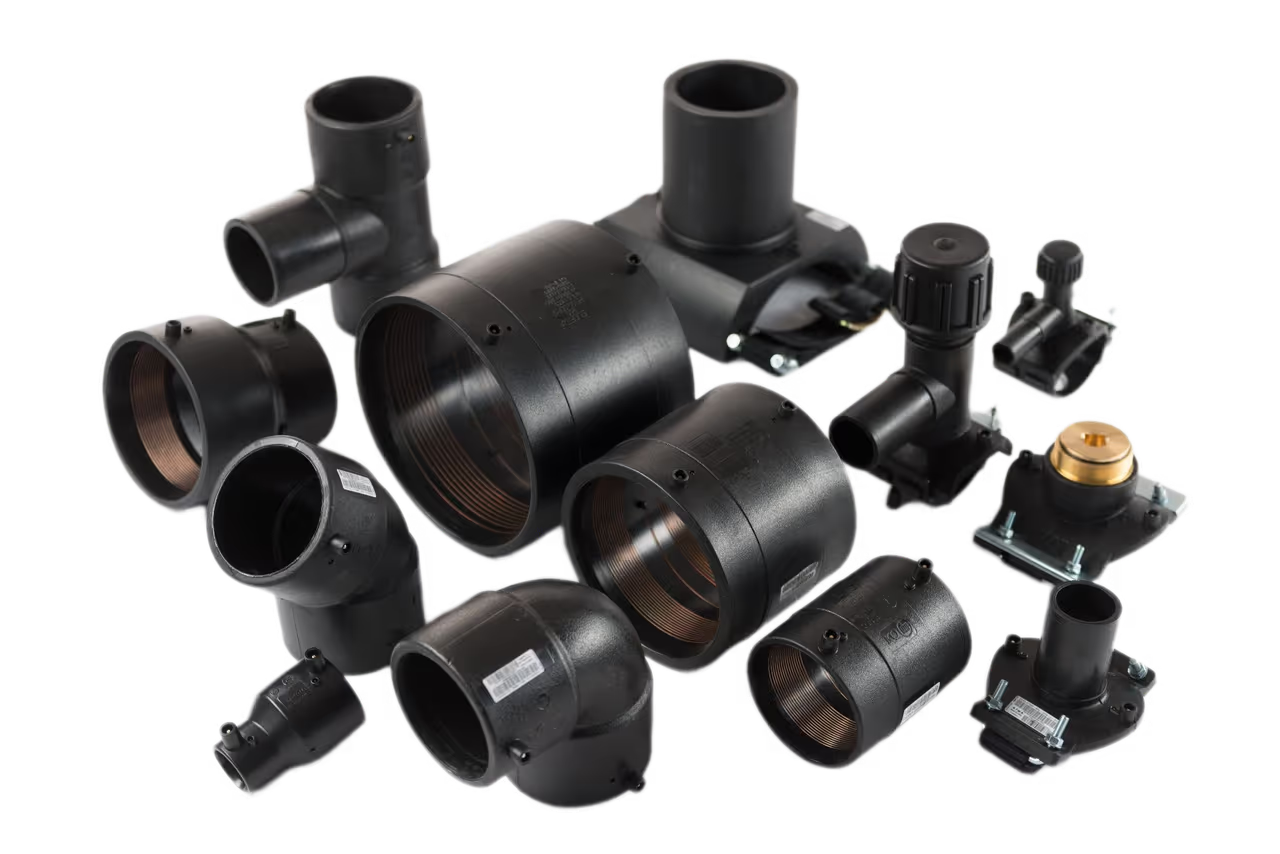
Electrofusion uses a fitting that does the heating itself. The fitting body carries an embedded resistance wire moulded into its inside surface. The two pipe ends are scraped to remove the oxide layer, slid into the fitting socket, and the welding control unit is connected to the two terminals on the fitting body. The control unit reads a barcode on the fitting that specifies the welding voltage and time, then drives the correct current through the wire to fuse the fitting socket to the pipe outside diameter.
No alignment rig is needed in the conventional sense — just a pair of pipe clamps to hold the two sections in place until the joint cools. The heating happens inside the fitting, the pipe outside surface partially melts, and the two materials re-crystallise as one. Cooling time is enforced by the control unit before the clamps may be released.

Where electrofusion shows its strengths
- Constrained access. A trench tie-in, a service connection to an existing main, or a repair on a buried line will rarely have the working space a butt fusion machine demands. Electrofusion only needs enough room to slide a fitting on and clamp it.
- Branches, reducers, and direction changes. Butt fusion can only produce a straight joint. Every elbow, tee, reducer, and transition on the network is an electrofusion (or moulded) fitting.
- Traceability per joint. Each fitting has a unique barcode and serial number. The weld log records the fitting ID, the pipe details, the operator ID, and the actual current and voltage profile through the cycle. The per-joint audit trail is stronger than butt fusion.
- Small-diameter networks. Service connections, internal gas piping, and small-bore industrial circuits are almost entirely electrofusion territory.
Side-by-side comparison
The project-level summary for HDPE work in Kuwait:
| Criterion | Butt fusion | Electrofusion |
|---|---|---|
| Pipe size sweet spot | 110 mm and up | 20 mm to 315 mm; up to 500 mm with large fittings |
| Fitting consumed at joint? | No — pipe-to-pipe | Yes — a coupler, elbow, tee, or reducer per joint |
| Per-joint material cost | Lowest, especially ≥ 200 mm | Higher — scales with fitting size |
| Working space at the joint | Generous — full machine envelope | Minimal — enough to clamp and connect |
| Direction changes / branches | Not possible | Native — tees, elbows, reducers |
| Operator skill burden | High — alignment, facing, force control | Lower — scrape, clamp, scan, run |
| Weld log granularity | Cycle data per joint | Cycle data plus unique fitting ID per joint |
| Controlling standard | ISO 21307 | ISO 12176-2 (equipment) / EN 13067 (operator) |
| Equipment portability | Trailer-mounted on larger sizes | Handheld control unit; mains or generator |
Butt fusion wins on straight runs of big pipe. Electrofusion wins on everything else. Most real projects use both, in proportions set by the network topology, not by ideology.
When to specify butt fusion
Butt fusion is the default jointing method on long, straight, larger-bore runs. On HDPE work delivered in Kuwait, that means:
- Trunk water mains and treated effluent lines in 200–630 mm. Once the run is laid out in a trench corridor, butt fusion drops the per-joint cost dramatically against any electrofusion coupler of the same size.
- Industrial process piping — brine, condensate, cooling tower returns, chemical dilution lines — where the pipe is largely straight and the joint count is dominated by length, not topology.
- Pre-fabrication off-site. A fabrication yard can weld long strings of pipe into transportable lengths, ship them to site, and complete the final tie-ins with electrofusion. The bulk of the welding happens under a roof in controlled conditions.
- Open-cut new builds where there is trench space to drop a butt-fusion machine alongside the pipeline.
When to specify electrofusion
Electrofusion is the right call wherever access, topology, or per-joint traceability dominates. The recurring patterns on Kuwait projects:
- Service connections and house tappings. Branch saddles, tapping tees, and reduction fittings are all electrofusion. A 200 mm trunk main carries a 32 mm service branch through an electrofusion tapping saddle and reducer.
- Repairs and tie-ins. Cutting in a new section, replacing a damaged length, or tying a new feed into a live main — all electrofusion. The working space is constrained, the joint must be made under tight clamp conditions, and the time-to-pressure-test is short.
- Direction changes and reducers. Any 45° or 90° bend, any reduction, any tee. The fitting type does the geometry.
- Gas distribution networks. The combination of small to medium diameter, the strict traceability requirement, and the high consequence of a bad joint pushes gas work almost entirely to electrofusion. Each fitting is logged with a unique ID against the network drawing.
- Confined site conditions. Plant rooms, vaults, manholes, chambers — nowhere a butt fusion machine fits.
The mixed-method project
Most real HDPE projects are not a choice between methods — they use both. A typical Kuwait pipeline scope looks like this in practice:
- The straight runs between chambers are welded by butt fusion, often in long strings pre-fabricated on the side of the trench.
- Every direction change, branch, reducer, and transition piece is electrofusion. So are all the tie-ins between the new run and existing infrastructure.
- Penetrations through chamber walls use electrofusion transition fittings (PE to brass threaded male or female) so the polyethylene side is fused and the metallic side is mechanically jointed inside the chamber.
- Repairs after pressure testing — almost always done with electrofusion repair couplers.
Specifying both methods on the same project is the rule, not the exception. The BOQ and submittal pack should reflect that: butt fusion equipment, electrofusion equipment, both fitting ranges, and trained operators for both methods.
Kuwait site conditions that move the decision
Three local realities push the method mix on most Kuwait pipeline scopes:
1. Ambient temperature
Summer ambient routinely exceeds 45 °C. Butt fusion cycle parameters are temperature-sensitive: cooling times lengthen, heater plate setpoint and soak time require operator judgement against the standard’s envelope, and the working window for the molten end after heater withdrawal shrinks. The controllers on modern butt fusion machines compensate for ambient, but operator skill and shaded working still matters. Electrofusion is less sensitive because the heating profile is barcode-driven and the control unit adjusts cycle voltage and time for the recorded ambient.
2. Sand and dust contamination
Dust and fine sand are the most common reason an HDPE joint fails inspection in the region. For butt fusion this means meticulous heater-plate cleaning and facing-immediately-before-fusion discipline. For electrofusion it means proper scraping of the pipe outer surface (a peeler tool, not a knife) and dry, clean fitting sockets. Both methods are unforgiving of contamination; electrofusion is slightly more forgiving in wind and dust because the fusion happens inside a closed socket.
3. Trench congestion and access
Urban Kuwait pipelines are routinely laid alongside existing services in narrow corridors. A butt fusion machine for 315 mm pipe occupies a working envelope that simply does not fit in many of those corridors. Long welded strings get fabricated on the verge or on a fabrication yard, and the buried tie-ins happen in electrofusion.
Equipment, traceability, and weld logs
The equipment side of the question matters more than the method, because the consultant’s submittal review is driven by what the machine records, not what the operator says. For a full walkthrough of selecting the machines themselves — including socket fusion and extrusion equipment — see the pipe welding machine buyer’s guide.
Butt fusion equipment
For Kuwait projects in the 110–315 mm range we typically supply the FRIATEC FDB-160 and the larger FDB-315 hydraulic machines. Both write a per-joint cycle log containing the pipe size, SDR, ambient, set parameters, actual parameters, and operator ID. The log exports as a PDF or CSV that goes straight into the submittal pack against the welded drawing.
Electrofusion equipment
The two control units that cover most of our scope are the FRIATEC FRIAMAT Prime Eco and the ELOFIT Elektra. Both are barcode-driven, both log per-joint cycle data with the fitting’s unique ID, and both export the weld history for submittal evidence. The Elektra is the working horse on most of our distribution and small-bore work; the FRIAMAT is specified where the consultant or owner has a FRIATEC-aligned approval pack.
What the weld log should contain
- Joint identifier mapped to the welded drawing.
- Pipe details — OD, SDR, manufacturer, batch (where recorded).
- Fitting details for electrofusion — fitting type, manufacturer, unique ID, barcode.
- Cycle parameters — set vs actual, ambient temperature, cooling time observed.
- Operator ID and training certificate reference.
- Time stamp and (where used) GPS location of the joint.
The log is what the consultant relies on. The fitting on the inside of the pipe is what the network relies on. They are not the same thing — both have to be right.
Submittal documentation
For consultant approval on a Kuwait HDPE pipeline scope, the working submittal pack typically contains:
- Pipe material certification to ISO 4427 for water, ISO 4437 for gas, or the relevant industrial standard.
- Fitting catalogue extracts for the electrofusion range to be used, with the manufacturer’s data sheets.
- Welding procedure specifications (WPS) for both methods, referencing ISO 21307 for butt fusion and the manufacturer’s electrofusion procedure.
- Operator certificates to EN 13067 (or equivalent) for the named welders on site.
- Equipment calibration records for the butt fusion machine and the electrofusion control unit.
- Sample weld log printouts from each machine.
- Pressure-test method statement tied to the system design pressure and the pipe SDR.
For the working product ranges, see the HDPE pipes and fittings page, the electrofusion fittings landing page, and the butt fusion fittings page. Welding equipment is consolidated on the welding machines page.
Frequently asked questions
Is one method stronger than the other?
No. A correctly executed butt fusion joint and a correctly executed electrofusion joint are both stronger than the parent pipe under both short-term burst and long-term creep testing. The performance gap between the methods is dwarfed by the gap between a clean joint and a contaminated joint.
Can the two methods be mixed on the same network?
Yes, and they almost always are. Mainline welded by butt fusion; branches, tie-ins, and direction changes by electrofusion. The two methods are designed to coexist and the same PE100 pipe sees both.
What pipe sizes do you stock for Kuwait projects?
We carry PE100 in standard utility sizes from 20 mm through 630 mm in the common SDR classes, with electrofusion fittings from FRIATEC and ELOFIT across the same envelope. See the HDPE pipes page for the working range.
Do you supply both butt fusion and electrofusion machines?
Yes. We supply FRIATEC butt fusion machines in the working size envelope and both FRIATEC FRIAMAT and ELOFIT Elektra electrofusion control units, with the peeler tools, alignment clamps, and consumables needed to run the equipment on site. The welding machines page lists the current scope.
Do you offer site training or operator support?
Yes. Commissioning and on-site operator training are available on request with the fusion machines we supply. Operator certification typically sits with the contractor and the manufacturer’s training partner. We also support site mobilisation by confirming machine setup, parameter selection for the supplied pipe and fittings, and helping interpret weld logs for submittal evidence.
How do I get a priced submittal for an HDPE scope?
Send the pipeline drawings, BOQ, or take-off through the contact page and the technical desk will return a priced offer with the right balance of butt fusion and electrofusion for the network, including the equipment and consumables list.
Send the pipe schedule, joint count, and the site constraints on the route. We quote pipe, fittings, and the matching fusion equipment as one coordinated package with the weld documentation.
Also useful:Electrofusion fittingsButt fusion fittingsFusion welding machines