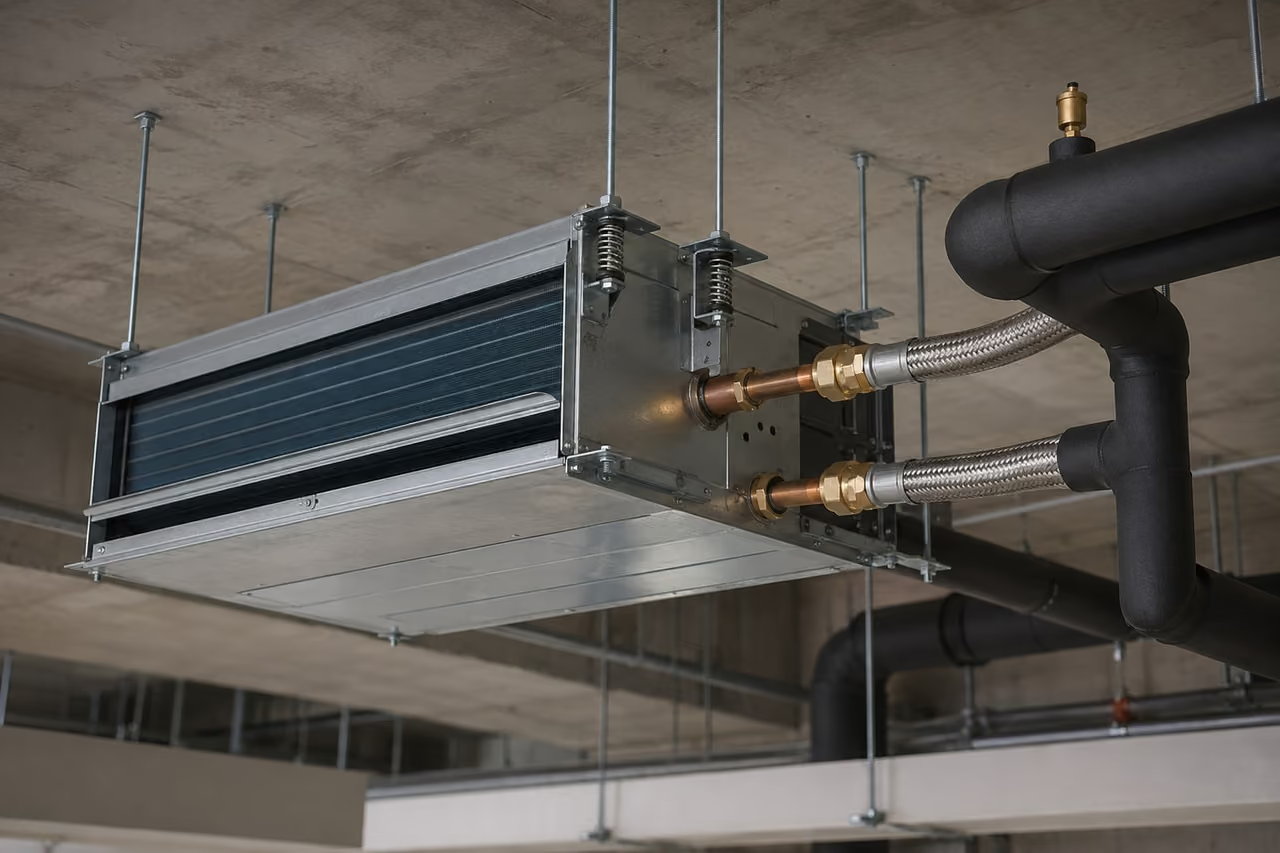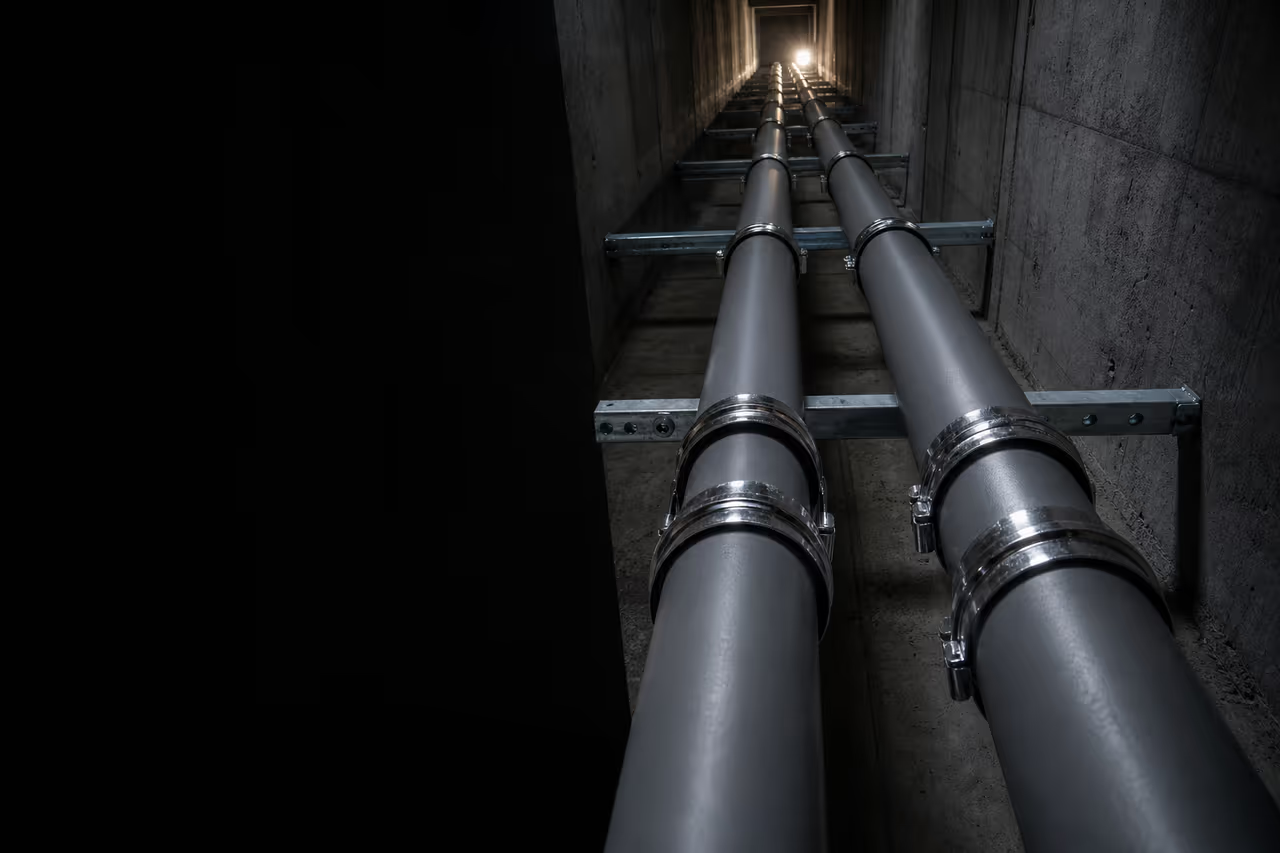
Pipe supports are the part of an MEP package that nobody photographs and everyone argues about. They decide whether a chilled-water riser sings or stays quiet, whether a sprinkler main passes its NFPA review the first time, and whether a plant room still looks tidy two years after handover. This is a working engineering guide to how supports get specified, selected, and approved on real Kuwait projects.
Why pipe supports actually matter
On every mechanical package, the support system is doing four jobs at once: carrying the dead and live load of the pipework, allowing or restraining thermal movement, isolating vibration from the structure, and giving the pipe a defined position so insulation, lagging, and adjacent services can be installed cleanly. When any one of those jobs is mis-specified, the symptoms usually show up downstream — cracked insulation jackets at hangers, sagging lines, transmitted plant-room noise, fastener pull-out at high points.
The reason a project team treats supports as a structural discipline rather than an accessory is that the cost of getting them wrong is paid years later, by the operator, on a building that’s already in use. Compliance is what pushes the cost forward into design and submittal — which is where this guide picks up.
The standards a submittal lives or dies on
For consultant approval on Kuwait MEP packages, two standards do most of the work, and a handful of finishing standards round out the rest:
- MSS SP-58 — Pipe Hangers and Supports, Materials, Design, Manufacture, Selection, Application, and Installation. The controlling design standard. It defines the type numbers (Type 1 through Type 59) that consultants use as shorthand on drawings — for example a clevis hanger is a Type 1 and a riser clamp is a Type 8. Since the 2009 revision it also carries the selection and application content, so one document now covers both what a support is made to and what it is selected for.
- MSS SP-69 — Pipe Hangers and Supports, Selection and Application.Withdrawn as an American National Standard in June 2014, with its contents folded into MSS SP-58. It still appears by name in plenty of Kuwait specifications, so it is worth recognising — but a submittal answering SP-69 is answered by the current SP-58, which MSS confirms may be referenced in its place.
- NFPA 13 — Standard for the Installation of Sprinkler Systems.Mandatory on fire-protection scopes. It governs hanger spacing, restraint, and listing requirements for sprinkler mains and branch lines, and is enforced against UL or FM-listed hardware on Kuwait fire scopes. This is the one an authority actually checks: NFPA 13 requires the hanger components themselves to be listed, which means a UL or FM certificate rather than a design standard.
- ASTM B633 — Electrodeposited Coatings of Zinc on Iron and Steel.The finishing reference for electrogalvanized hardware, with service classes (SC1 through SC4) that map to corrosion exposure.
One distinction is worth carrying into every submittal: MSS SP-58 has no third-party certification scheme behind it. It is a design and manufacture standard that a manufacturer declares conformance to, usually through a published guide specification. UL listing and FM approval are the opposite — independently tested, certificate-numbered, and verifiable in the UL and FM directories. Both belong in a submittal, but only one of them is something a third party has checked.
On industrial and seismic-rated scopes, project specifications also reference ASCE 7 for seismic loading and FM 1950 for sway-brace listings. The full standards register for our supply scope is captured on the pipe supports product page.
MSS SP-58 type numbers at a glance
A clevis hanger is MSS SP-58 Type 1, a riser clamp is Type 8, a sprinkler band hanger is Type 10, beam clamps are Types 19 and 23, and rollers run from Type 41 to Type 45. The standard numbers every support pattern from Type 1 to Type 59; these are the ones that recur on Kuwait HVAC, plumbing, and fire schedules, with the range that covers each.
| MSS SP-58 type | Support | Where it goes | Range |
|---|---|---|---|
| Type 1 | Adjustable steel clevis hanger | The standard hanger on horizontal plumbing, HVAC, and fire mains; levelled from the rod | UL/FM clevis hangers, DN15–750 |
| Type 6 | Adjustable swivel pipe ring (split ring) | Lighter services and short runs; the lined version over occupied rooms | EPDM-lined split clamps, DN15–80 |
| Type 8 | Extension pipe or riser clamp | Vertical risers, bearing on the slab at each floor | Riser clamps |
| Type 10 | Adjustable swivel ring band hanger | Sprinkler branch lines and mains reviewed against NFPA 13 | UL/FM sprinkler hangers, DN20–200 |
| Types 13, 14, 17 | Steel turnbuckle, steel clevis, weldless eye nut | Rod hardware: adjustment and the top connection of a hanger drop | Threaded rod and fixings, M6–M100 |
| Types 19, 23 | Top-beam C-clamp; C-clamp | Rod from a beam flange, purlin, or channel without welding or drilling | Beam clamps, M10/M12 rod |
| Type 24 | U-bolt | Pipe held to strut, steel, or a trapeze | Strut channel systems |
| Type 35 | Pipe slide and slide plate | Guided sliding supports on runs that move axially | Pipe supports range |
| Types 39, 40 | Pipe covering protection saddle; protection shield | Insulated chilled-water and hot-water pipe at every hanger, so the insulation is not crushed | Pipe supports range |
| Types 41, 43, 44, 45 | Single pipe roll; adjustable roller hanger; pipe roll complete; pipe roll and plate | Long hot or cold runs that expand along their axis | Roller supports, DN50–750 |
Two things a schedule reviewer looks for beside the number: the type number and the model on the BOQ must agree, and conformance to SP-58 is declared by the manufacturer — there is no third-party SP-58 certificate. The independent marks are UL listing and FM approval, which is why the fire-protection lines carry them and the HVAC lines normally do not.
The seven support types you’ll specify
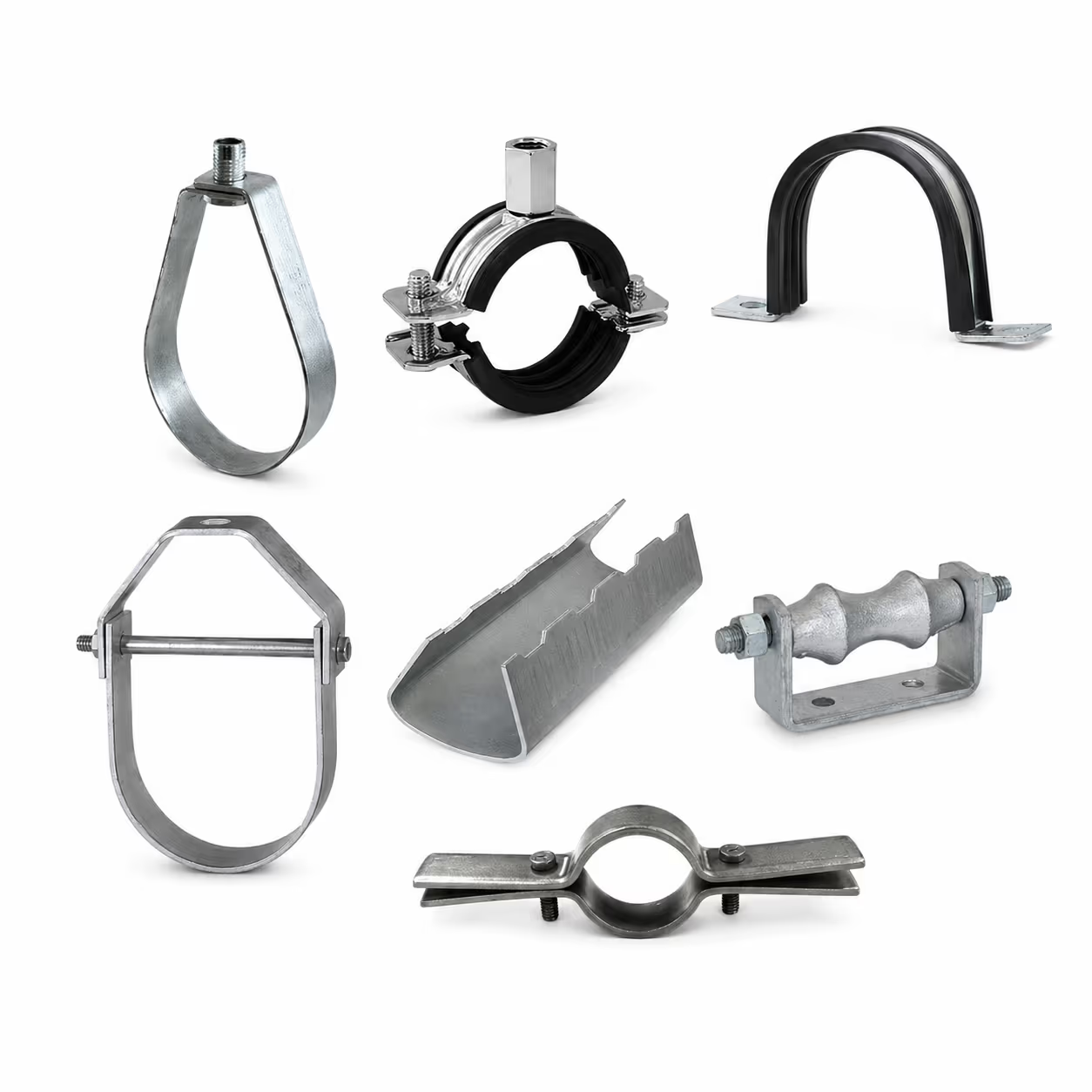
Almost every mechanical scope in Kuwait can be supported with seven types of hardware — the same types that make up our pipe hangers and supports range. The combination depends on the service, the pipe size, the structure, and the fire and acoustic constraints in the specification.
1. Clevis hangers and split rings
The default vertical support for horizontal pipe runs. A UL/FM-listed clevis is the standard hanger on plumbing, HVAC, and fire-protection mains; a split ring or loop hanger is used on lighter services and shorter runs. The clevis is the Type 1 in MSS shorthand — if you only specify one component on a project, this is it.

2. Strut channels, trapezes, and cantilever arms
Modular framing for multi-service runs — a single trapeze can carry chilled water, condenser, and a small-bore drain at one elevation, with cantilever arms used where wall-mount support is preferred over overhead. Strut channel systems are the right answer wherever cable trays, pipework, and ductwork share a service zone and the project wants a consistent installation grid.
3. Riser clamps and split clamps
Vertical pipework needs its own support type. Riser clamps transfer the column load to a structural slab; rubber-lined or EPDM-lined split clamps grip the pipe without damaging the surface, dampen vibration, and prevent insulation chafing on clamped sections. On chilled-water risers in towers, the lined split clamp is what keeps the line quiet.
4. Roller supports, anchors, and guides
On any service that moves — chilled water, low-temperature hot water, steam, or process — thermal expansion has to be allowed at the supports. Cast-iron roller chairs let the pipe slide longitudinally; anchors fix the pipe at a single point so the expansion is forced toward the loop or expansion joint; guides constrain lateral movement so the pipe runs true. Get the anchor-to-roller-to-loop sequence right and the line stays where it is supposed to be.
5. Sprinkler hangers, sway braces, and seismic restraints
Fire protection has its own support category because NFPA 13 demands it. UL or FM-listed sprinkler-pipe hangers, four-way sway braces, and longitudinal restraints prevent the system from whipping during a seismic or surge event. Listings and certificates have to match the model on the BOQ — a generic hanger does not pass an NFPA review.

6. Beam clamps and structural fixings
Beam clamps attach threaded rod and hanger assemblies to structural steel without field welding. They are quick, repeatable, and removable — which matters on fit-out scopes where the structural drawings prohibit welding to the beam flange. For concrete soffits, drop-in anchors and concrete inserts replace the beam clamp on the same hanger assembly.
7. Threaded rod, fixings, and accessories
The hardware that turns the supports above into a finished assembly: threaded rod in the right diameter and grade, drop-in anchors, concrete fixings, nuts, washers, and the accessories required for a consistent on-site install. Specifying the rod grade is not a small detail — on heavy services, an under-graded rod is what eventually pulls out of a slab.
Support schedules and fixing requirements
Hanger spacing, rod grades and anchor selection belong in the project’s engineered support schedule. Send the approved drawings, pipe sizes, insulation thicknesses and finish requirements so we can quote the matching TEMBO products and accessories.
Browse the pipe hangers and supports range for product types, fixing accessories and finish options.
Materials, finishes, and lining choices
Material and finish selection on a Kuwait project is driven by three things: the service the support carries, the corrosion environment, and the fire or insulation rating attached to the pipe. The working palette:
- Carbon steel — the default base material for indoor plumbing, HVAC, and fire-protection supports. Specified with one of three finishes:
- Electrogalvanized to ASTM B633 SC3 — clean indoor plant rooms and ceiling voids. Service-class SC3 is the working baseline.
- Hot-dip galvanized — outdoor plant, exposed pipe racks, roof-top equipment, and any service zone that sees humidity or condensation.
- Epoxy powder-coated — where colour-coding by service is part of the specification, or where the consultant requires a higher indoor finish.
- Stainless steel SS304 / SS316 — coastal exposure, marine environments, sterile or pharma applications, and any project where chloride carry-over would attack a galvanized surface. SS316 specifically for direct coastal exposure.
- EPDM rubber lining on split clamps — rated −20°C to +110°C, used wherever the support has to dampen vibration, protect the pipe surface, or maintain insulation continuity.
On a project with mixed indoor and outdoor scopes, mixing finishes inside the same BOQ line is normal. The submittal package needs to call out which finish goes where.
Applications across MEP services
HVAC: chilled water and condenser
Chilled-water risers and headers want lined split clamps on the riser, clevis hangers with insulation-protection saddles on horizontal runs, and roller supports on the long thermal-expansion sections downstream of the plant. Condenser-water lines on outdoor plant runs sit on hot-dip galvanized hardware because the condensation is constant. Where the pipework meets pumps and chillers, flexible pipe connectors absorb the equipment vibration before it reaches the first hanger.

Fire protection: sprinkler mains and branches
UL or FM-listed clevis hangers, four-way sway braces, and longitudinal restraints, all sized and spaced against NFPA 13 and the consultant’s sway-brace schedule. The submittal pack lists the listing certificate against every line on the BOQ — this is the single biggest cause of NFPA review comments and is also the easiest to get right at submittal stage.
Plumbing: domestic water and drainage
Split rings, riser clamps, threaded rod, and channel systems for hot, cold, soil, waste, and vent. On villas and low-rise residential, the hardware is mostly electrogalvanized; on towers, lined split clamps on the riser keep the pipe quiet through the floors.

Industrial: process and utility racks
Heavy-duty anchors, guides, rollers, and fabricated supports for pipe racks, utility corridors, refineries, and power plants. Material and finish selection moves toward stainless and hot-dip galvanized; the structural calculation behind each support gets longer; and the documentation pack starts to look like a structural submittal in its own right.
A practical selection workflow
On a Kuwait project, the workflow we’ve seen work consistently runs in this order:
- Read the spec twice. The first read for the standards (MSS SP-58, NFPA, project-specific seismic), the second for the fine print on finishes and listings.
- Walk the BOQ against the standards. Tag every line that requires a UL/FM listing, every line where the finish is implied rather than stated, and every line where the support is missing entirely.
- Map the support type to each service. Clevis on horizontals, riser clamps on verticals, lined clamps on chilled-water and noisy services, rollers on thermal-movement runs, anchors at fixed points, sway braces on fire mains.
- Pick the finish from the environment. Indoor clean dry → electrogalvanized SC3. Indoor humid or service zone → hot-dip. Coastal or chloride exposure → SS316.
- Confirm the listings before issuing the submittal. UL or FM certificates need to match the model number on the BOQ exactly, not a similar model from the same range.
- Send the package as a coherent set. Cover sheet, BOQ, type schedule, listings, finish certificates, installation drawings. A reviewer with all of that in front of them clears a submittal in one round; without it, you’ll be in three.
Submittal and approval notes
A submittal pack we’d hand to a consultant looks like this:
- Cover sheet — project name, BOQ revision, supplier of record, contact for clarifications.
- BOQ-aligned schedule — every line item with its MSS type number, material, finish, listing reference (where applicable), and the catalogue page reference.
- Catalogue cut-sheets — one per line item, the matching page from the manufacturer’s catalogue.
- Listings and approvals — UL, FM, ASTM, MSS, and any project-specific certifications, with the model number visible on the certificate.
- Finish documentation — ASTM B633 service-class declarations on electrogalvanized lines, mill certificates on stainless lines, coating-thickness statements on hot-dip lines.
- Installation guidance — recommended spacing per pipe size (tabled in MSS SP-58), sample fixing details, and a torque table for the bolted connections.
For Kuwait projects, the same pack also tends to include the supplier’s company profile, partner authorization letters, and country-of-origin declarations. The full partner catalog page carries the brochures we hand over with the submittal.
The best submittal is the one a consultant approves without coming back with comments. That’s the bar — everything else is rework.
Frequently asked questions
What standards do your pipe supports comply with?
Our pipe support range is manufactured to MSS SP-58, which since 2009 also covers the selection and application content previously issued as MSS SP-69, with UL listings and FM approvals on fire-protection items where the specification requires them. The full register is on the pipe supports product page.
Can you quote from a BOQ or support schedule?
Yes. Send the BOQ, support schedule, or drawing take-off through the contact page and our technical team will return a priced offer with type numbers, finishes, and listings against every line.
Which finish should I specify for Kuwait coastal projects?
Hot-dip galvanized for outdoor exposure away from immediate coastal carry-over; stainless steel SS316 for direct coastal exposure or where chloride attack is a risk. Electrogalvanized SC3 stays inside dry plant rooms and clean ceiling voids.
Do you supply UL/FM-listed sprinkler hangers?
Yes. UL/FM-listed sprinkler-pipe hangers, sway braces, and longitudinal restraints are part of the standard fire-protection range, with listing certificates supplied as part of the submittal pack.
Do you supply seismic bracing?
Yes — sway braces, longitudinal restraints, and seismic hardware to suit the project’s ASCE 7 / IBC seismic categories, with the bracing schedule sized against the consultant’s seismic submittal.
How far apart should pipe hangers be?
Follow the project’s engineered support schedule for hanger spacing, rod grades and anchors. The design depends on the pipe material, service, insulation, operating conditions and installation requirements. Send the approved schedule with your enquiry so we can quote the specified supports.
Send the BOQ, support schedule, or drawing take-off and our technical desk returns a priced, submittal-ready package with MSS type numbers, finishes, and UL/FM listings against every line.
Also useful:Pipe hangers & supportsUL/FM clevis hangers (Type 1)Sprinkler hangers (Type 10)